
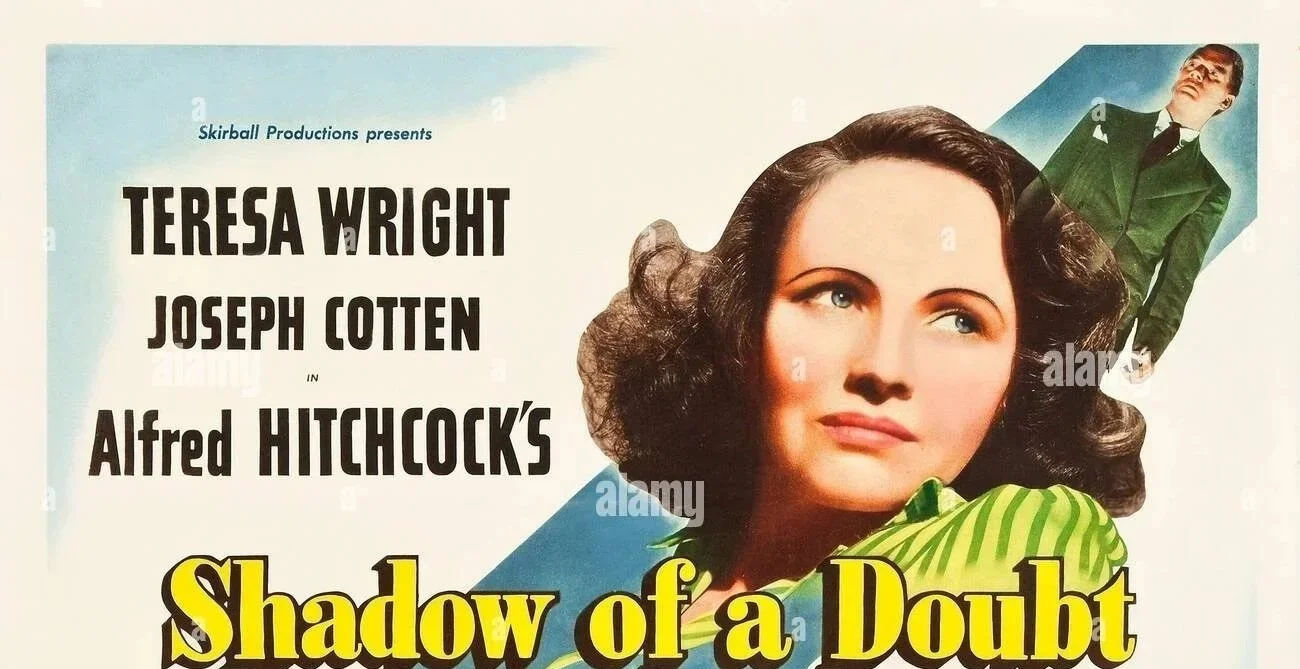
Episode 62: Shadow of Doubt (1943)
Guest: Daniel Ortiz
Listen Anywhere You Stream
~
Listen Anywhere You Stream ~
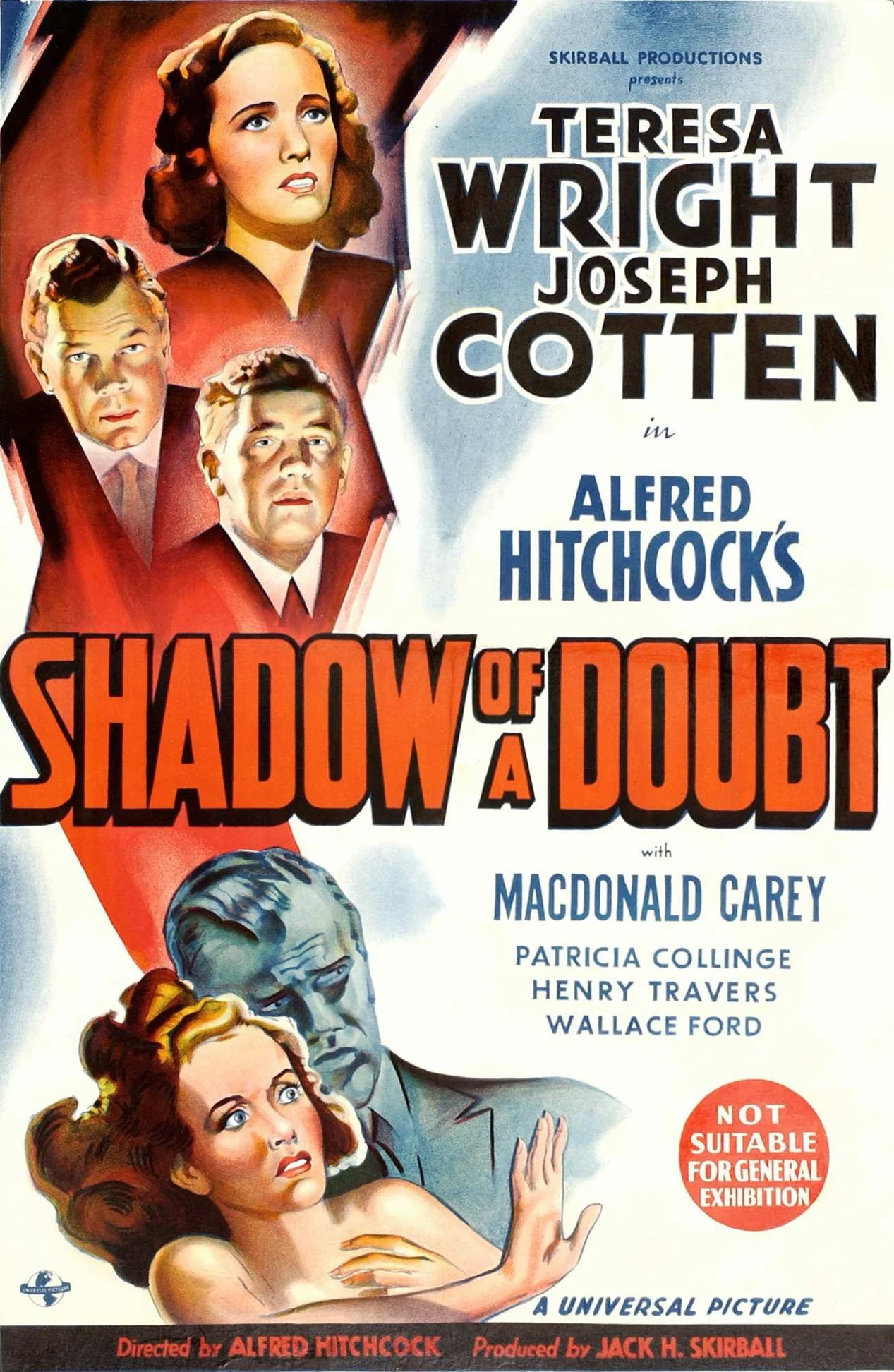
Alfred Hitchcock’s Shadow of a Doubt (1943), sets a murder story inside what seems the safest place imaginable: an ordinary American family in an ordinary American town. But as suspicion gathers around Uncle Charlie (Joseph Cotton), the film slowly exposes something more unsettling than a single killer on the run. It reveals how charm, respectability, and social status can insulate wrongdoing from scrutiny — and how communities prefer comforting narratives to disruptive truths. The police investigate, but they move hesitantly; the town remains confident in its own innocence. The real drama unfolds not in the courtroom, but at the dinner table. The film explores law’s capacity — and its limits. How does misogyny operate not just as motive but as ideology? What happens when loyalty to family collides with loyalty to justice? And in a film released at the height of World War II, is Hitchcock warning that the most dangerous threats to democracy are not always foreign invaders, but may also be charismatic figures embedded within everyday life?

27:48 Playing with crime genres and narrative structures
32:58 Hitchcock’s cameo
5:16 Doubling and other filmic techniques
48:19 Complicity in covering up the evil
51:11 Wartime idealism and the narrative of the enemy within
56:17 Questioning American institutions
0:00 Introduction
2:13 Teaching law students through film
5:54 Shadow of a Doubt and law’s inadequacies
11:11 The film’s setting and Santa Rosa, CA
14:54 Imagining the perfect crime
21:21 Misogyny in Shadow of a Doubt
Timestamps
-
00;00;16;27 - 00;00;47;21
Jonathan Hafetz
I'm Jonathan Hafetz and welcome to Law on Film, a podcast that explores law through film and film through law. Each episode focuses on a different film to examine the various ways law operates across institutions, society and culture, not just inside, but also outside courtrooms. This episode, we look at Alfred Hitchcock's 1943 film shadow of a doubt. In the film, Hitchcock sets a murder story inside what seems the safest place imaginable an ordinary family, an ordinary American town.
00;00;47;21 - 00;01;14;06
Jonathan Hafetz
But a suspicion gathers around Uncle Charlie, played by Joseph Cotton. The film slowly exposes something more unsettling than a single killer on the run. It reveals how charm, respectability and social status can insulate wrongdoing from scrutiny and how communities prefer comforting narratives to disruptive truths. The police investigate, but they move hesitantly. The town remains confident in its own innocence, and the real drama unfolds not in the courtroom but at the dinner table.
00;01;14;10 - 00;01;43;12
Jonathan Hafetz
My guest today is Daniel Ortiz. Daniel Ortiz is the Michael J. And Jane R Horvitz Distinguished Professor of Law at the University of Virginia School of Law, where he teaches constitutional law, administrative law, electoral law, civil procedure, and legal theory. From 2006 to 2023 directed the law school's Supreme Court Litigation Clinic. Professor Ortiz is the recipient of the Z Society Distinguished Teaching Award at the University of Virginia, among other honors.
00;01;43;13 - 00;02;05;03
Jonathan Hafetz
He previously served as a law clerk to then Judge Stephen G. Breyer of the U.S. Court of Appeals for the First Circuit in Boston, and for U.S. Supreme Court Justice Louis F Powell, Jr. For the last 20 years, he's taught a short course at UVA as part of the Law School Seminar and Ethical Values program on film, most often the films of Hitchcock and Pedro Almodovar.
00;02;05;07 - 00;02;08;21
Jonathan Hafetz
Professor Ortiz, Dan. Welcome to law on film.
00;02;08;25 - 00;02;13;13
Daniel Ortiz
Thank you. Jonathan, I'm so happy and excited to be here. This is wonderful.
00;02;13;15 - 00;02;29;27
Jonathan Hafetz
So let's start with this course that you teach or you've taught for a while at UVA, and just a little bit about how you use film in the class. And you know why filmmakers like Hitchcock or Almodovar are good for, you know, teaching law students.
00;02;29;29 - 00;02;56;10
Daniel Ortiz
The program has been around for about 30 years, and it was started by a group of alums who wanted students to actually half of the opportunity to deal with real ethical problems, but not issues of professional responsibility. I mean, all law students have to take a course in professional responsibility, of course, but they thought, you know, this is really about, you know, what bank account you should put your client's money in.
00;02;56;11 - 00;03;23;09
Daniel Ortiz
Conflicts of interest, that kind of stuff. And there's really missing out at the larger issue of ethics and law. So they funded this program, which basically sets up a bunch of 12 person classes that typically meet for 5 or 6 times during the year at the instructors house over dinner, maybe a bottle of wine or two, that sort of thing.
00;03;23;10 - 00;03;49;18
Daniel Ortiz
And some of them are focused on books. Some of them are focused on film. Some of them are focused on video, some of them on all of the above. You know, that sort of thing. And basically the particular issue that a class will tackle is up to the instructor. And so of course, voluntary on the part of students, they don't receive any kind of grade for it, but they do get a single credit.
00;03;49;19 - 00;04;12;18
Daniel Ortiz
Now, I've done film with a friend of mine who taught in the Spanish department, and we typically bounced back from the films of Hitchcock, the films of Alma Dover. But we've done Billy Wilder, Federico Fellini and some others. But recently we're now in a kind of Hitchcock rut, which is a nice place to be as far as I'm concerned.
00;04;12;18 - 00;04;47;04
Daniel Ortiz
And we do it because we think that the students we are. Particular seminar has six law students and six graduate students from the College of Arts and Sciences. They can come from all over. So we've had people from French departments, Spanish department, architecture school, engineering department, physics department, you name it. We've had them over time and we find that they really bring a different perspective than the law students do, and they really sort of nudge the law students out of their very comfortable ways of looking at ethical issues from a kind of legalistic perspective.
00;04;47;05 - 00;05;11;03
Daniel Ortiz
So we'll also really gain a lot. We've also found that law students read too much, if you will. Everything in class, especially one L, is text, text, text, text, text. And so we thought they'd have. Designing a course around film would actually be a kind of relief to them and fun. But we've also found is that many law students don't know how to watch a film.
00;05;11;04 - 00;05;45;27
Daniel Ortiz
They've been raised on James Bond films, superhero films, things like that, maybe the odd romcom, and it's as if film is a kind of entertainment, but it's not really serious, and so you don't really have to pay much attention to it. You're there just for the spectacular effects or to have your heart tugged at kind of thing. But we think with Hitchcock and Alan Dover in particular, we can really teach people skills that they can take away from our class and use just to watch, you know, ordinary or more ordinary films.
00;05;45;27 - 00;05;47;07
Daniel Ortiz
So it's really wonderful.
00;05;47;11 - 00;06;06;08
Jonathan Hafetz
Yeah. I think it's so interesting that, you know, you focus on Hitchcock and Alma Dover. I mean, you know, Hitchcock and particular, you know, shadow of a doubt you don't really think of as a law firm obviously involves a murder, but it's not a police procedural, really. There's a detective but doesn't follow that. There's no court, there's no trial.
00;06;06;09 - 00;06;09;21
Jonathan Hafetz
So it's an interesting choice for the course.
00;06;09;22 - 00;06;40;01
Daniel Ortiz
Well, it is, it is. I mean, but it's really a film about American institutions and law is one of them. So you think there are two FBI agents basically in the film who are chasing someone they think might be a serial murderer on the West Coast, and they have another pair on the East Coast, and we never really see after the first minutes of the movie, who were chasing another person that the FBI thinks might be the serial killer.
00;06;40;01 - 00;07;11;14
Daniel Ortiz
And, you know, the interesting thing I know there's a spoiler alert here is that at the end, the law, at least as represented by the FBI and as publicly reported by news stations in the movie, has caught the serial killer. But of course, they caught the wrong one, and they let the real one off free. And this poor, innocent man whom they've caught dies while they're chasing him by running into an airplane propeller.
00;07;11;19 - 00;07;45;06
Daniel Ortiz
So it really doesn't say much. That's very good or hopeful about the laws. Capabilities actually work justice. It not only lets the guilty guy off, but it condemns the very gruesome death of presumably innocent man. So, you know, it's clear that law is inadequate in that sense, and it doesn't accomplish what we like in law school. At least we like to pretend, think, whatever that it does.
00;07;45;06 - 00;08;06;25
Daniel Ortiz
And so to the extent that there is any sort of real justice being done here, it's got to work through alternative means, other institutions. And there are a lot of like institutions other than law that are figured in the movie. So one of the most uncomfortable scenes, I think, to ordinary people watching the movie is an odd one.
00;08;06;26 - 00;08;37;24
Daniel Ortiz
It occurs in a bank where the heroine, whose name is young Charlie, she was named after her uncle. Uncle Charlie, who's the anti-hero, if you will, of the of the piece. Her father works basically as a glorified bank teller, hoping to get a promotion later on, and Uncle Charlie comes into the bank and just starts embarrassing everyone. And by asking his brother in law he can stop embezzling for a moment so he could actually take a deposit.
00;08;37;29 - 00;09;08;03
Daniel Ortiz
But you know, saying it a loud tone of voice that everyone in the bank can hear it and everyone is sort of horrified by it. Another institution is American religion. There are two really important scenes that happen, especially at the very end happens at a church. It's a funeral, and we hear the funeral in the background. But of course, we understand that it's more covering up what's happening rather than actually working out any kind of justice or sense of truth.
00;09;08;03 - 00;09;34;04
Daniel Ortiz
And of course, there's the central institution in the film, which is the American family most. As you said, most of the interesting scenes happen around the dinner table. One of the perhaps most formal moments in American family life. There are scenes that happen in the bedrooms of these places. Again, the most private spaces in the American family, you would presume.
00;09;34;04 - 00;09;59;16
Daniel Ortiz
And so one of the questions, perhaps the biggest question that the film raises is, you know what? How does the American family, which we like to idealize, actually function, especially when there is this huge secret? But it's not just the family. There are all these other institutions that are invoked. The law, of course, they say they're the FBI agents.
00;09;59;16 - 00;10;37;16
Daniel Ortiz
But there's also it works on the level of the traffic warden, who is telling people when they can cross the street. And of course, young Charlie, because she's emotionally upset and hurry two points basically violates the law there and is pretty severely reprimanded for it by the representative of law on the ground. But again, that guy was completely unhelpful in terms of separating her from danger because her uncle comes up to her and grabs her away from him.
00;10;37;16 - 00;10;55;21
Daniel Ortiz
So it is it is about law, but it's mostly about laws, inadequacies and whether the other institutions which operate American institutions, which operate along with law, are likewise inadequate to actually accomplish anything.
00;10;55;23 - 00;11;23;05
Jonathan Hafetz
And these institutions are set right. The bank, the church, the family, in this case, young Charlie, the right characters family are set in the idyllic town of Santa Rosa, California, right? Which is where Charlie Joseph Cotton character flees from the East coast, from the urban scene to this idyllic landscape. So how does the setting sort of inform the movie in some of these themes?
00;11;23;09 - 00;11;23;29
Jonathan Hafetz
Well.
00;11;24;00 - 00;11;57;04
Daniel Ortiz
First of all, the film starts in a very different location, which is important when the film opens with the credits, there are a bunch of dancing couples doing the Merry Widow Waltz, which is very formal, orderly, controlled, highly structured, and then the film fades into this desolate wasteland. My apologized anyone in new Jersey, but it's basically what the screenplay identifies as the Jersey marshland, with Jersey city in the background.
00;11;57;08 - 00;12;27;05
Daniel Ortiz
We now euphemistically refer to it, I think, as the Meadowlands, but that's what it is. It's completely desolate. There's a carcass of an old car there, no dumping sign there. What looked to be like two hobos who are sitting on the edge of a river at the very beginning, and then the camera goes into this room where the character Uncle Charlie, played by Joseph Cotton, is staying, and he's lying on a bed smoking a cigar.
00;12;27;08 - 00;12;52;12
Daniel Ortiz
But again, it's all black and white. There's his landlady comes in. But the media, the media beginning is this film would have signaled a film noir. And in fact, there's a voiceover which you typically find in film noir at the very beginning. And then Uncle Charlie finds that these FBI agents are on his tail. They don't know what he looks like, though he's in plead unknown to them.
00;12;52;12 - 00;13;17;20
Daniel Ortiz
So taking risks as he does. He's a great risk taker. He walks right by them, and then they realize later where he came from and tried to chase him, but he eludes them. And then he goes to the west coast, and we see him coming in on the train to Santa Rosa. Now, Hitchcock had to do, had to actually use film on location, because this was during the war.
00;13;17;22 - 00;13;52;06
Daniel Ortiz
The script was basically was written 4142. It was filmed in 42, released in early in 43. So, you know, the wars in the background and under war regulations, the film studios were not allowed, I believe, to spend more than $5,000 on set building for a single film. So they had to film on location. And Hitchcock and his wife, who was his great helper, scouted many different places and fell in love with Santa Rosa because to them it represented the All-American town.
00;13;52;08 - 00;14;13;11
Daniel Ortiz
It was small, but still big enough to have like bank and people and things like that. But idyllic people were still friendly. Families talk to each other. People in the street talk to each other. There wasn't much crime. People seem to believe and like all the things that Americans at the time you said thought that they should believe in the church.
00;14;13;18 - 00;14;39;14
Daniel Ortiz
You know, the banks, you know, that kind of stuff. So it really was a perfect location. And once it moves, of course, you still have the secret, but you have the secret not working in the kind of film noir world which it started in, but now within the heart of the American, this all American family, which gives it a real edge and power.
00;14;39;16 - 00;15;23;08
Jonathan Hafetz
One of the interesting things I think about this in this idyllic situation and, you know, which seems to provide what critics like Robin would have said, you know, for Hitchcock's critique of American bourgeois normalcy. But here is this sort of like two levels. You have this idyllic setting, but you also have the discussions, the abstract, playful discussions of murder by young Charlies father, Joseph Newton, Henry Travers character and his friend Herb Hawkins, the Cronin character where they seem every time they get together, they should have obsessive discuss crime fiction and forensics and try to one up each other with increasingly creative, intellectual and gruesome scenarios.
00;15;23;11 - 00;15;36;27
Speaker 3
Well, how's everything? Say, have you read this one? That little Frenchman leads them all. You can talk all you like about Sherlock Holmes. That little Frenchman beats them all. I read it, yeah.
00;15;36;28 - 00;15;43;24
Speaker 4
Bubbles don't necessarily kill a person who's writers from the other side. Get to fancy the best way to commit a murder.
00;15;43;26 - 00;15;47;23
Speaker 3
I know, I know, hit him on the head with a blunt instrument.
00;15;47;27 - 00;16;08;16
Speaker 4
Well, it's true, isn't it? Listen, if I wanted to murder you tomorrow. Do you think I'd waste my time on Fancy hypodermic or on any any Indian arrow poison? Listen, I'd find out if you were alone. Walk in. Hit you on the head with a piece of lead pipe or a loaded cane.
00;16;08;17 - 00;16;13;07
Speaker 3
Want to be the part of that? Where's your planning? Where's your clues?
00;16;13;08 - 00;16;18;05
Speaker 4
I don't want any clues. I want to murder you. What do I want with clues?
00;16;18;07 - 00;16;21;08
Speaker 3
Well, if you haven't got any clues, where's your book?
00;16;21;11 - 00;16;25;22
Speaker 4
I'm not talking about writing books. I'm talking about killing you.
00;16;25;24 - 00;16;47;10
Speaker 3
Well, if I was going to kill you, I wouldn't do a dumb thing. Like hitting you on the head. First of all, I don't like the fingerprint angle. Of course, I could always wear gloves. Press your hands against the pipe after you were dead and make you look like a suicide. Oh, except it don't seem hardly likely that you'd beat yourself to death with a club I'd meridia, so didn't look like writer.
00;16;47;13 - 00;16;56;25
Jonathan Hafetz
So I don't know. What do you make of this? Of the way these discussions operate against the backdrop of what's going on with Charlie, the Joseph Cotton character?
00;16;56;28 - 00;17;24;04
Daniel Ortiz
Well, most obviously, I mean, they work as a kind of comic relief and a kind of comic parallel to what's going on. There's certainly that, but I think that he functions on several deeper levels as well. I mean, for one, I mean shows the cluelessness of most people. I mean, these are two guys who are going around trying to one up each other on the best way to kill the other with this type of poison.
00;17;24;05 - 00;17;40;12
Daniel Ortiz
Be best would be better. To drown you in a bathtub. Will be better to hit you over the head with a lead pipe. You know, that sort of thing. Did you notice that I put baking soda in your cup of coffee? No you didn't. Well, actually, then I could have put poison in there. And you could have been dead by now because you wouldn't.
00;17;40;13 - 00;18;07;17
Daniel Ortiz
The the poison wouldn't have taste any worse than the baking soda did. So this constant, like comic commentary, which shows their cluelessness. Right? They have no idea. And perhaps because of the community they're embedded in, they have no idea of the seriousness of any of the things they're talking about. You know, murder is something that happens in a magazine.
00;18;07;18 - 00;18;42;08
Daniel Ortiz
Maybe a French magazine is not really anything that's in the community itself. You can joke about it. You can play with it partly because it is just so far away, and it would never intrude in the community. There's also the question of why are they so interested in it? I mean, it's really bizarre and a little bit uncomfortable, right, that these two upstanding citizens and young Charlie's father is a member of the establishment at the bank, you know, find this.
00;18;42;09 - 00;19;12;14
Daniel Ortiz
They're just, like, compulsively engaged in this. Whenever they're together. It's the only thing they can really talk about. You know, it suggests that, again, in a somewhat comic register, that there's something like this in all of us that, you know, we don't want to talk about it, we don't want to admit it. But we're not only fascinated by this stuff, but we like moths flying, you know, flying around the flame.
00;19;12;14 - 00;19;39;24
Daniel Ortiz
We want to get really close to it, touch it, even though it's incredibly dangerous. And of course, the comedy neutralizes that to a degree. But it also allows Hitchcock to intensively focus, focus, focus on it. And again, I think also Hitchcock is doing one other, at least one other thing with it. When you watch a film, you often want to say, you know, where am I located in this film?
00;19;39;27 - 00;20;20;12
Daniel Ortiz
Is there a character who is like me, who is experiencing what's happening in a way I might? Are there maybe 2 or 3 different characters that I'm sort of seeing things through? But each one represents a bit of me, you know, kind of thing. And I think here Hitchcock is saying, listen, you know, you're watching this movie and you are as ridiculous or dangerous or whatever as these two people that you're laughing at, who you think are clueless, who don't understand what's going on even though there's a murder, you know, they're, like, really engaged in murderer and attempted murders.
00;20;20;12 - 00;20;46;04
Daniel Ortiz
So all around the danger is really there and they just don't see it. So again, you know, that's probably our lives to but also and I think perhaps most tellingly for Hitchcock, it's this idea of like, why are you so engaged with this? Should you be ashamed in watching this? It's a little bit like a movie he directed about a decade later called Rear Window, which is all about voyeurism.
00;20;46;04 - 00;21;04;26
Daniel Ortiz
There's this newspaper photographer who breaks his leg and has to stay off his feet in his own apartment, where he can just watch all his neighbors all the time, and he discovers a murder, among other things. It covers a lot. But one of the things that, you know, Hitchcock is asking us is, you know, to judge him, should he be watching his neighbors.
00;21;05;02 - 00;21;22;16
Daniel Ortiz
But of course, we are doing the same thing in the act of watching the movie. So I think his cock wants us to ask these kinds of questions about ourselves. When he shows those two characters talking about ways of offing people.
00;21;22;18 - 00;21;48;27
Jonathan Hafetz
Another theme, sort of, which we see is that of misogyny in the film, right? I mean, we have wow. Yeah. I mean, and so I think there's a couple levels. One is the way the treatment of young Charlie, but also just in terms of Uncle Charlie, Joseph Cotton character, when he articulates his philosophy of contempt. And it's right in the middle of this dinner table, the family institution you talked about.
00;21;49;01 - 00;21;55;09
Speaker 5
John, I promise, Mrs. Green, the president of Ireland, that you talked to the ladies and she wants to know what are you going to talk about?
00;21;55;10 - 00;21;55;26
Speaker 3
Well, what am.
00;21;55;26 - 00;21;59;29
Speaker 6
I going to talk about? Lectures usually give them a travel a current events don't they.
00;22;00;02 - 00;22;02;27
Speaker 5
Oh, Charles. Not current events. We get current events.
00;22;02;29 - 00;22;04;12
Speaker 6
It's not of an audience would be.
00;22;04;18 - 00;22;08;06
Speaker 5
All women like myself. Busy with our homes. Most of us.
00;22;08;07 - 00;22;32;25
Speaker 6
Women keep busy in towns like this. The citizens. Different cities are full of women, middle aged widows, husbands, dead husbands who spent their lives making fortunes working and working than they die and leave their money to their wives, their silly wives. One of the wives do these useless women. You see them in the hotels, the best hotels every day by the thousands.
00;22;32;28 - 00;22;47;11
Speaker 6
Drinking the money, eating the money, losing the money at bridge. Playing all day and all night. Smelling of money. Proud of their jewelry but of nothing else. Horrible, faded, fat, greedy women.
00;22;47;13 - 00;22;50;04
Speaker 5
They're alive. They're human beings.
00;22;50;07 - 00;23;03;16
Speaker 6
Are they? Are they Charlie? Are they human or are they fat? Freezing animals? What happens to animals when they get too fat and too old? Well, I seem to be making my speech right here.
00;23;03;17 - 00;23;22;09
Speaker 5
Well, I have them say, don't talk about women like that in front of my club. You'll be tired and feathered. The idea and that nice Mrs. Potter is going to be there, too. She was asking me about you. The Greens are bringing her here to the little party I'm having for you after the lecture. Joe, it's Herbert.
00;23;22;11 - 00;23;29;14
Jonathan Hafetz
So what is this rhetoric reveal about misogyny, mid 20th century America or any other themes about the movie?
00;23;29;21 - 00;24;10;29
Daniel Ortiz
Well, it's funny, to my mind, this is one of Hitchcock's least misogynistic movies, although it has the most misogyny in it. People probably aware of, you know, Hitchcock's bad behavior, to put it mildly, with some of his leading women late at the end of his career, like Tippi Hedren, Kim Novak, the sort of cold, Hitchcock blond types. Tippi Hedren wrote a basically memoir, which she talked about how bad a sexual harasser Hitchcock was during, specially during the filming of Marnie, but also during the filming of The Birds.
00;24;11;02 - 00;24;38;02
Daniel Ortiz
This I think this film, on the other hand, I think is one of the ones that really shows women well. But there is more misogyny in it, but it's not. I would say in its in the movie, but it's not misogyny that the movie ever adopts itself. The primary character who exhibits misogyny is Uncle Charlie, and in that clip you just played, wow.
00;24;38;04 - 00;25;30;14
Daniel Ortiz
I mean, that is one of the most amazing things that you'll find in the Hitchcock movie, but it's said by character that we are meant to, I think, condemn and despise, but at the same time identify with, not identify with happily, but identify with as representing being a little bit like us at the time. And I think, you know, when we see that, especially since it's at a dinner table and the family is sort of celebrating something, this is, you know, one of the most formal moments in American domestic life, the old fashioned family dinner, it, you know, really causes us to pull ourselves up and saying, what is going on?
00;25;30;15 - 00;26;00;14
Daniel Ortiz
You know, this is just completely be completely inappropriate anywhere. But to have this said at a family dinner is really appalling and, you know, shakes us up and makes us want to judge what's going on. And all the other characters, of course, rush in their various ways to try to evade it. So Uncle Charlie's sister tries to joke no about it.
00;26;00;15 - 00;26;32;17
Daniel Ortiz
Say, I was saying, well, don't tell that to my women's club when you give the speech tomorrow or whatever the speech at the women's club is, because they'll call her and feathered you, and it shows how even something so repulsive people can and will tolerate or won't perhaps formally repudiate as strongly as they should because of this web of different relations that we're all enmeshed in here, primarily the family.
00;26;32;18 - 00;26;56;24
Daniel Ortiz
Will that be said? Young Charlie does no strongly condemn what he's saying. But again, she's negotiating and thinking about how independent she should be from him. She's she's at that point, she understands that he's done some pretty bad stuff, is a pretty bad person. But on the other hand, she has this really weird relationship with them where, as they both say, they are twins.
00;26;56;24 - 00;27;33;24
Daniel Ortiz
She was named after him. It's at least a quasi romantic relationship, and it gets sort of weirdly sexual or weirdly sexualized in some places. That makes you want to say, you know what is going on here, pull back, don't go there kind of thing. But again, I think, you know, Hitchcock is saying, you know, this unfortunately, is maybe a truth or partial truth about at least some American families, which we actually portray as happy.
00;27;33;26 - 00;27;48;02
Daniel Ortiz
ID look innocent and it just doesn't work. And the old phrase, he's showing us the skull beneath the skin, and that's one of the points where he's doing it. And it's just that's particularly where he's doing it with gender.
00;27;48;04 - 00;28;12;12
Jonathan Hafetz
I mean, it's interesting that young Charlie is the one who isn't oblivious, right? She's the one who discovers the truth. I mean, she knows more than you know the detective, right? Which is the McDonald Carey character. The main detective who Charlie also sort of has some kind of relationship with. But he's seemingly ineffectual. She's the one who kind of discovers what's going on.
00;28;12;13 - 00;28;39;29
Daniel Ortiz
Yeah. No, she works very hard to discover what's going on. And again, I think this is Hitchcock weeding yet another kind of narrative structure. So we have here we've mentioned so far the film noir. We've mentioned the family domestic drama. There's also the rom com drama which you just pointed to. You know, she falls in love. Although I think we're at the end, were meant to question it a little bit with this FBI agent.
00;28;39;29 - 00;29;07;04
Daniel Ortiz
But, you know, one of the other central narratives, structures that the film is playing with is what used to be called the gumshoe set narrative, the the young girl. This is Nancy Drew, if you will, who is actually the one who, despite all the grown ups around her, actually discovers what's going on. Now, of course, there it's primarily a kind of entertainment, sort of innocent.
00;29;07;04 - 00;29;31;12
Daniel Ortiz
There's not often like real serious crimes, sort of lesser, you know, that kind of stuff. But, you know, she's the hero and she's the only one who has the insight and the skill to be able to solve these crimes. The usual police are sort of useless as as you say. And so I think, you know, Hitchcock is employing that narrative structure on steroids here.
00;29;31;12 - 00;30;04;27
Daniel Ortiz
There's also another one which is related to it, but different, which is the woman detective and the woman detective narrative. The woman is typically trying to save her guy, who's suspected of a crime and is liable to go off to the electric chair or something like that. And that's happening at the same time, a much less innocent level, because, of course, for that narrative to work, typically the woman has to be the romantic interest or deeply romantically interested in the man.
00;30;04;27 - 00;30;27;26
Daniel Ortiz
And here that's her uncle. Come on, you know, that's really creepy. But again, Hitchcock just brings in all these different ways of seeing the structure because they all invoke different kinds of values and make you see it from different kinds of perspective. The rom com, as opposed to the noir, whatever. And he just presses and presses and presses them so they don't really fit anymore.
00;30;27;28 - 00;30;43;11
Daniel Ortiz
One doesn't fit any better than the other or the way to make it fit. It has to make you really uncomfortable. So do you see the possibility of maybe romance, the sort of sexual romance within the family itself? Now he's exploding my head at that point.
00;30;43;13 - 00;31;02;02
Jonathan Hafetz
Yeah. It's so interesting how he plays with the different genres. And you mentioned the film noir where it starts, right? It really feels like a newer film in the beginning and some of the camera angles. But one of the things that differentiates it, and there are probably multiple, is the detectives McDonnell Carey character is not the noir hardboiled detective, right?
00;31;02;03 - 00;31;11;23
Jonathan Hafetz
I mean, I think there are other distinctions, but that seems one of them, because, you know, initially it really does. It feels like you're starting with like Asphalt Jungle or something like that. It's like a real noir film.
00;31;11;25 - 00;31;36;23
Daniel Ortiz
But it's interesting because he sort of very quickly migrates over from being this real sort of hardcore detective, which he is even in Santa Rosa at the very beginning, because he and his sidekick basically trick the family into thinking they want to get a picture of Uncle Charlie, and they want to sort of interview the family and figure out what's going on, to see if this is the guy that thereafter.
00;31;36;23 - 00;32;21;01
Daniel Ortiz
So they tell the family that they are doing a survey for some government entity on the All-American ordinary family, and they're going to come in and take pictures of the House. They want to talk to them all. They want to see the mother making a cake kind of thing. And so there is betrayal there. But again, to make it work, he has to be this largely non-threatening good guy, which causes him, I think, to very quickly in the movie, transition over to the rom com narrative where, you know, there's this a horror detective, and he tells young Charlie some hard truths at some point, so she doesn't want to hear about her uncle or possibilities
00;32;21;01 - 00;32;51;15
Daniel Ortiz
about her uncle, because it's not clear there that he's the actual bad one. But again, he's also playing the rom com lead, and it's trying to play those two roles at the same time. That makes you unhappy, I think in both of them. But actually puts creates a new kind of narrative role for you, which we don't often see now in the traditional war narrative, we usually see the anti-hero acting as romantically the kind of inverse flip of the typical rom com.
00;32;51;18 - 00;32;58;15
Daniel Ortiz
Whereas here, you know, the the detective is actually going into the romantic comedy lead.
00;32;58;17 - 00;33;07;17
Jonathan Hafetz
Hitchcock also places himself in the movies he does and others with a cameo, but it's a little bit of an unusual cameo here.
00;33;07;19 - 00;33;33;10
Daniel Ortiz
Oh, this is one of his greatest cameos. As you said in just about every film, he just puts a little picture of himself. Sometimes it's a shape, and in rope it was a shape and lighting in the background and building in New York, often he's carrying a musical instrument on or off a train, or he's just walking down the street, or he's winding a clock, as he does in Rear Window, but he just makes an appearance and it doesn't really mean anything.
00;33;33;17 - 00;34;09;10
Daniel Ortiz
His appearance here is actually very interesting. As the train comes in to Santa Rosa, Uncle Charlie is basically hiding in a birth, pretending as a migraine headache or something, and so no one will see him and he's traveling under a pseudonym. But we see some people outside the birth in the same train car. We see the back of someone who turns out to be Hitchcock, and we see a man and wife across from him were playing him, it turns out, in a game of bridge and the man and his wife sort of talk, and then we see the man as a doctor, and his wife says we should help the guy who's up in the
00;34;09;10 - 00;34;32;25
Daniel Ortiz
birth, who's having all this trouble. And the guy says, no, I'm on vacation. I'm not going to to help them. And then the man looks at Hitchcock, whom he's playing in bridge, and says, you don't look very well either. And then we looked down from Hitchcock's perspective and we see his hand, and he has a full suit of spades, which is the best hand you can have in bridge.
00;34;32;25 - 00;34;58;01
Daniel Ortiz
And I think the chances are like 1 in 2,000,000,000 you would ever actually be dealt it. So I think there Hitchcock is telling us one, well, you should distrust what you see, what you think, what the impressions are. Because I'm in control here. To the extent that this the film is a game. No, you're suspending disbelief. We're playing.
00;34;58;01 - 00;35;16;02
Daniel Ortiz
You and I are playing by certain rules. You're not going to beat me, right? This is my game, and I'm going to win. You're at my mercy. So I think in more ways than one. Hitchcock in the cameo here is showing his director's hand.
00;35;16;05 - 00;35;33;00
Jonathan Hafetz
And he does seem to manipulate but sort of control. Or you really steer the audience. And in terms of what they, what they see. And I mean, I don't know, there's some ways that other ways that Hitchcock is kind of controlling what's going on through his choices.
00;35;33;01 - 00;36;02;29
Daniel Ortiz
Oh, yeah. I mean, a lot of it is just like his film filmic technique. One of the primary spaces in the film is the staircase in the house. There are two staircases in the house. There's one in the back where a murderer almost occurs, and there's one within the house, which is, you know, you would think like, you know, all domestic and nice, which connects all the different kinds of space, interior spaces within the house.
00;36;02;29 - 00;36;26;24
Daniel Ortiz
But, you know, when we see the staircase, it is offering frightening because there are shadows that are caused by the slats and the banister or the columns on the banister, whatever you call them on the wall, there are shadows of people going up and coming down as they're walking. Of course, the shadows distort them and make them seem very ominous.
00;36;26;26 - 00;37;09;10
Daniel Ortiz
Often Hitchcock will film, say, someone like uncle. Uncle Charlie at the top of the stairs, looking at young Charlie at the bottom. And it's completely frightening because of the the camera angle primarily. So he's using these like, just camera techniques, if you will, to great effect to set the mood. Another place where when the train comes into Santa Rosa, into this ideal like town, Hitchcock famously had the train company put something, a chemical into the fuel so that the engine would belch basically pure black.
00;37;09;13 - 00;37;33;23
Daniel Ortiz
There's no reason why the train would do that. The trains of the time didn't. When the train at the end, at the very end takes Uncle Charlie away, you can see the the steam coming from the steam engine. It's white. It's not black. So it's almost as if, you know, Satan is coming into this idyllic American town and it's just set by the the shot and the color.
00;37;33;23 - 00;37;42;03
Daniel Ortiz
And of course, it's all black and white, but I mean, everyone notices the deep, dark smoke as the train comes into town.
00;37;42;06 - 00;38;03;13
Jonathan Hafetz
Masterful. So, I mean, one of the more or less subtle choices is, of course, the double name, right? I mean, you know, the Charlie, Joseph, Cotton and young Charlie. And so mirroring, right, is a technique of mirroring. What I mean, this is obviously a deliberate choice. I mean, what is he telling us with, you know, this mirroring of the two name, you know, the two names.
00;38;03;13 - 00;38;04;22
Jonathan Hafetz
And that's a very consciousness.
00;38;04;27 - 00;38;28;16
Daniel Ortiz
The movie is the movie is full of doubles, starting from the title shadow of a doubt. You know, the shadow is a kind of doubling of something, but it's a distorted representative, notes reduced as two dimensions, typically, but it's also distorted in different kinds of directions. There are two detectives on two coasts. There are two people who might be the serial killer.
00;38;28;17 - 00;38;59;01
Daniel Ortiz
One of the most important scenes in the film occurs at a bar called till, to, where Uncle Charlie drinks two double brandies and is served by waitress who started work there two weeks before. Right. So just the number two, the idea of doubling the idea of twins. Both young Charlie and Uncle Charlie call the other twins, you know, in the movie is incredibly important here.
00;38;59;01 - 00;39;37;04
Daniel Ortiz
And I think what's happening in Hitchcock is going out of his way to structure the movie as doubles and to make people think of it. Now, of course, when you think of doubles, you think both well, it's two of the same, but also more importantly, they're not actually the same. They're very different. And it makes you think about confusion, doubt, identity, why we might want to conflate something or think that things are the same when in fact they can't possibly be the same.
00;39;37;04 - 00;39;55;20
Daniel Ortiz
And in fact they may be opposites. So in a sense, you know, Hitchcock is throwing the whole epistemology of the film, if you will. I know it's a fancy term, but it's also one in the title, like shadow of a doubt. How do you know? How can you be certain? How do you know? You know? How can you feel that you actually understand something?
00;39;55;21 - 00;40;32;18
Daniel Ortiz
And he's constantly inviting us to assume something and then yanking the rug out from our understanding in a way which just completely unsettles us. So there are no sources of what you might think of as truth in the movie. Like the newspapers, the library, sources of knowledge. And so they do play that role. I mean, it's in the library, after all, which sort of looks oddly like a haunted house where young Charlie finds out really the truth of what happened.
00;40;32;19 - 00;40;46;26
Daniel Ortiz
But again, it's a kind of truth that is mediated through this, like amusement park, funhouse, haunted house kind of things like Dracula's castle. It's, you know, it's kind of crazy.
00;40;47;03 - 00;40;59;12
Jonathan Hafetz
Yeah. And things like the closeness of maybe innocence and evil with the two. Right. With, you know, they're close there, you know, Charlie Young, Charlie and Uncle Charlie. I mean, they're saying, but I know it makes maybe fix the audience feel something about the.
00;40;59;18 - 00;41;19;22
Daniel Ortiz
Well, yeah, but but it's also creepy in a way. So we first see Uncle Charlie lying in bed in new Jersey, smoking his cigar as the. And the camera comes sort of through the window, and you see the shadows from the slats on the window and the slats of the curtain on his face and behind him on the head stand.
00;41;19;22 - 00;41;41;27
Daniel Ortiz
And then we were introduced to young Charlie in the same way the camera comes through the window of the house in Santa Rosa. Of course, the lighting is different, but there's still the shadows, and she's lying on the bed in exactly the same position that Uncle Charlie was. And of course, they share the bedroom. They sleep in the same bed different times, but they sleep in the same bed.
00;41;41;29 - 00;42;08;07
Daniel Ortiz
The bed that we see here at the beginning is the bed that her family gives to Uncle Charlie while he's living there. So there's this weird. I mean, it's like both Charlie's in bed, you know, at the same time. There are members of the family. It's, like, really creepy. But also, you know, as you pointed out, like, there's situations where there's this kind of doubled ness that should make us feel good, which instead makes us feel really uncomfortable.
00;42;08;07 - 00;42;36;11
Daniel Ortiz
So one of the more famous scenes in the movie, Uncle Charlie, gives presents to all the members of the family around the dinner table, and they turn out to be things that he's collected from the women, the rich women that he's killed. And he gives a stole a kind of meek stole to his sister. He has a watch to his brother in law, gives some other things to the other kids, and then he goes to give something to young Charlie, and she says, no, no, no, you can't give me anything.
00;42;36;11 - 00;43;04;12
Daniel Ortiz
I don't want anything to would spoil or relationship. And she goes into the kitchen and he's tremendously sort of upset. And so he goes into the kitchen to and then he shows her what he would give her, which is this ring, and then puts it on her finger. And it's like a betrothal scene, which is again, you know, requires two people and is one of the most significant moments between two people, especially like in film and literature.
00;43;04;14 - 00;43;37;01
Daniel Ortiz
And it's obviously invoking this motif, but it's just like, makes you completely uncomfortable. What is this uncle doing with his niece? And again, why is the niece letting this happen to her? But you know, she's actually sort of sexually romantically, whatever. It's unclear interested in him, but it just makes us all the audience, I think, you know, really extremely uncomfortable by toying with the idea that they're the same.
00;43;37;04 - 00;43;52;20
Daniel Ortiz
They see themselves as the same or especially together, but it's incredibly inappropriate for them to be that way. And again, it's the family that makes that possible, hides it, if you will.
00;43;52;23 - 00;44;08;00
Jonathan Hafetz
And the ring, of course, has, because Uncle Charlie neglects to take off the engraving has the deceased widow's initials or name on it, and it ends up being sort of, you know, one of the things that caused young Charlie to realize what happened.
00;44;08;03 - 00;44;38;27
Daniel Ortiz
Yeah. No. So she notices at that scene that it has something written in it. She doesn't understand what it is. But Uncle Charlie didn't apparently didn't know that that was engraved or had forgotten about it and explained and says that he must have been ripped off by the jeweler. But then the ring is an incredibly important plot device, because when she goes to the library to read the newspaper article, the Uncle Charlie has taken so much effort to rip out the newspaper and hide from everyone in the family.
00;44;39;02 - 00;45;14;24
Daniel Ortiz
She discovers that it's about the serial murderer, and it mentions that his last victim was a mrs. something so-and-so, formerly a comedic actress under a different name. And when she looks at the ring, she sees the initials of the comic actress and the initials of her later husband there. And at that point, the game is up. She knows exactly what has happened, although she still, on one level doesn't want to believe it, and she knows she can't, but she's willing to sort of cut him a little slack.
00;45;14;24 - 00;45;20;04
Daniel Ortiz
She wants not to believe that it's possible, although at that point. How could it be otherwise?
00;45;20;06 - 00;45;38;01
Jonathan Hafetz
And so the betrothal is like almost now, like the betrayal or something. I mean, like she's like, yeah, another the doubling occurs to me is also with the beginning, and you reference the ending with the train pulling away or at the beginning in terms of the arrival in Santa Rosa on the train and then the ending or the penultimate scene.
00;45;38;02 - 00;45;48;26
Jonathan Hafetz
Right is the climax is when Uncle Charlie is now leaving on the train, but he sort of tricks young Charlie into staying on and then attempts unsuccessfully to murder her.
00;45;48;28 - 00;46;10;15
Daniel Ortiz
Yeah. So, you know, when the when the train arrives in town, Uncle Charlie gets off it, but because he's told all the people on the train that he is sick, he has to pretend to be sort of disabled and trouble walking and all this. So a young Charlie sees him from the other end of the platform and is obviously confused and worried.
00;46;10;16 - 00;46;47;17
Daniel Ortiz
Then he sees her, and by that point, the people who helped him off the train are back on the train, and the train is about to leave, and he suddenly, you know, as this kind of instant healing and starts walking up to her jauntily and they embrace in this, you know, wonderful scene that is twinned with the scene at the the train scene at the end, which is absolutely remarkable, where he asked young Charlie and her brother and sister to come up on the train just so they can see it, and then lets the younger brother and the younger sister get off, but doesn't let Charlie get off.
00;46;47;17 - 00;47;16;23
Daniel Ortiz
And then the train starts moving, and then she runs into the little compartment at the end of the area, end of the train, and we see the train gaining speed as Uncle Charlie wrestles with her and tells her that she knows too much and will have to die, and she struggles to hold on to the train and he, you know, struggles to get control of her and ultimately does get control of her.
00;47;16;24 - 00;47;36;14
Daniel Ortiz
She's looking out the window or the the back of the train. And he says, not yet, Charlie. The train isn't going fast enough. And he makes her look at the rails that are speeding by. And so she realizes that she's going to be thrown from the train when it reaches a fast enough speed that apparently she will be done for.
00;47;36;14 - 00;48;02;08
Daniel Ortiz
And so you see her head, you see their legs fighting. Then you see her hand on the side and she pushes, changes the position and then throw a man. Just throw him off the train, just as another train is coming in the other position. And it's not hard to imagine what happens to him. As you say, though, that's twinned with the train scene at the beginning.
00;48;02;10 - 00;48;31;04
Daniel Ortiz
Both of those scenes involved two people basically embracing but embracing very different ways. The first one represents new life coming into Santa Rosa and Charlie's life. The second one presents the end of life in the great bookends. That said, you carefully noted that that wasn't the last scene of the film. It's the penultimate scene, and it's very important that the last scene, which is very short, follows it.
00;48;31;06 - 00;48;37;22
Jonathan Hafetz
Yeah, because I mean, in the last scene you have well, the scene between young Charlie and the detective.
00;48;37;29 - 00;49;19;12
Daniel Ortiz
Yeah. So young Charlie, the detective are sitting outside the church during Uncle Charlie's funeral, which everyone in town has come for. And you hear the sermon being given at the funeral while young Charlie and Jack Graham, the FBI agent, are outside and they're listening to it, and the sermon is basically praising Uncle Charlie for being everything an American should be the perfect person for the community, an upright citizen person who loved his family brought joy to everyone.
00;49;19;12 - 00;49;46;08
Daniel Ortiz
But of course, young Charlie and Jack Graham. And as she hears this, she grabs his hand romantically. And they are the ones, of course. No, this is just the opposite is the case that Uncle Charlie represented everything that is bad in America, and took advantage of all the ways that people, all the things that were good in America to get away with what he did, he undermined the family.
00;49;46;08 - 00;50;16;28
Daniel Ortiz
He undermined the bank, he undermined the widows, everything. But they are unwilling to actually correct the record and to let anyone know who he really is. So at the end of the movie, everyone, the people in Uncle Charlie's family, except for young Charlie, the people in the town, the people in the church, they all think that Uncle Charlie was everything that is right and wonderful about America, when of course, he's just the opposite.
00;50;16;28 - 00;50;48;16
Daniel Ortiz
And this kind of complicity that young Charlie has with that. She doesn't want to tell anyone, primarily because it would upset her mother is what actually enables all this evil in the world. So in the end, although she murders a murderer. I mean, she doesn't self-defense. Of course, but she to put an end to this has to do exactly the same thing that he did over and over and over again to a member of her own family.
00;50;48;16 - 00;51;08;02
Daniel Ortiz
And then she has to allow everyone else, maybe even encourage everyone else, not to understand who he was, what happened. How the world works is really, I think, you know, great indictment about all these American institutions, in particular the family and the church.
00;51;08;04 - 00;51;32;23
Jonathan Hafetz
Yeah. And the pastoral idea. We've talked a lot about the about Santa Rosa and the place, but the time is also important, right? This film was made in 1943. So the height of World War two. We talked a little bit about that at the outset in terms of the budget and the sort of the fear of fascism. How is that a sort of a in the backdrop of the film?
00;51;32;25 - 00;51;52;08
Daniel Ortiz
Oh, many, many, many ways. So first of all, all the other films, just about all of them, not all of them were popular during this year, were all war movies. So this would have stood out as very different kind of movie. There were, at the time, a lot of what you want to call propaganda movies that would be shown as shorts in the film.
00;51;52;08 - 00;52;24;14
Daniel Ortiz
There may have been one shown at, you know, showings of shadow of a doubt. I don't know, that would try to show people what America was fighting for, so would portray institutions like the family and the kind of wonderful way. So this is, you know, quite a risky film for Hitchcock, because he was actually asking people to question many of the things that people were fighting for at the time.
00;52;24;14 - 00;52;48;08
Daniel Ortiz
So there is this life in Santa Rosa. And of course, you know, that's what people we were sending our troops over to fight for. But of course, it wasn't really what it seemed to be or what we wanted it to be. There's no express, if you will, invocation of the war in the film. Which is odd, because the trains, you know, there's a train here, but trains were constantly moving troops.
00;52;48;14 - 00;53;13;01
Daniel Ortiz
The first scene, the war scene, was shown on the waterfront. The military ships were often going off to say, no, it's not that. There's no mention of the war really in the film by any of the characters, but of course the audience was living it and knew this at all the time. And at the same time there were a lot of silent invocations of the war in the film itself.
00;53;13;01 - 00;53;36;29
Daniel Ortiz
So someone watching it, even if they weren't in America at that time, would have completely understood what was going on. So you go to the bank there, all these posters for military bonds. You go to the bar, the till two bar, they're all in the there's another bar, sort of a nicer bar called the Gunners Point or something like that.
00;53;36;29 - 00;54;02;08
Daniel Ortiz
And they all have military recruitment posters or war posters in them. You look at the people who are in Santa Rosa and there are a lot of ordinary people, but there are a whole bunch of military types, people walking around in uniform like, you know, maybe every fifth person or something like that. It's, you know, pretty amazing. If you just stop the film and actually, you know, count the numbers.
00;54;02;09 - 00;54;25;04
Daniel Ortiz
And as far as I'm aware, there wasn't really a big military base anywhere near Santa Rosa. So that had to be intentional on on Hitchcock's part. And he's working, you know, with some of the sort of military, some of the war movie themes, as I said, you know, protecting all that is right in America, heroic. But he's invoking it in reverse.
00;54;25;04 - 00;55;04;21
Daniel Ortiz
He's questioning it, which I doubt you would have thought that that would have been maybe frightening. But oddly, though, the original reviews didn't really pick up on it at all. And there's also, on a deeper level, he's also using some of the narrative structure of some war movies, but in completely different ways. So one way of viewing the film is that he is using the narrative of The Enemy Within, but translating it from a political, military, economic context to a familial one.
00;55;04;21 - 00;55;26;09
Daniel Ortiz
So now the enemy within is a member of the family who is thinking of betraying the family, who is engaging in domestic client wants to kill a member of the family. So it's taking this one grand narrative, which everyone would have been aware of at the time, and transplanting it in a way which I think is really effective.
00;55;26;09 - 00;55;33;12
Daniel Ortiz
But again, I don't know that anyone would have identified as a war movie move at the time.
00;55;33;14 - 00;55;41;17
Jonathan Hafetz
Yeah, it doesn't feel like a woman, but you said it's in the backdrop. I mean, you can see it in some of the scenes in the backdrop, but also the anxieties.
00;55;41;20 - 00;56;10;22
Daniel Ortiz
I mean, there's also at this point that you mentioned, which I think is fascinating, which is are the conditions within the family in American society which enabled Uncle Charlie the same kinds of ones which we claimed at the time enabled fascism. Is it, in a sense, making us wonder whether some of those evils are within ourselves? I think it does.
00;56;10;24 - 00;56;17;06
Jonathan Hafetz
Are there any other things that stood out to you about the film that you think are important to address?
00;56;17;09 - 00;56;43;07
Daniel Ortiz
Well, I think what's most important to realize is how Hitchcock is holding up all these American institutions, one right after another and asking us to question them. And he's doing it at a time, as you say, when was important for people to actually believe in these institutions and to celebrate them because we were fighting for them and people were dying for them.
00;56;43;07 - 00;57;11;05
Daniel Ortiz
And it wasn't as if Hitchcock was unpatriotic. I don't think that was in the picture at all. You know, he was making some propaganda movies at the same time or shortly thereafter. So, you know, he was doing his bit. But at the same time, he thought it was important for us to actually ask ourselves these questions and to be painfully realistic, maybe even a little cynical about it.
00;57;11;05 - 00;57;23;19
Daniel Ortiz
So, you know, it's just amazing to me that he could be asking these questions about the American family at a time when we were at war, and a lot of people were dying to save exactly this.
00;57;23;22 - 00;57;37;07
Jonathan Hafetz
And in terms of his overall work, where do you where do you place shadow of a doubt? In some sense, I'm thinking thinking add to psycho. There seemed to be some shades of that here, but you mentioned rope, you mentioned your window and the voyeurism.
00;57;37;12 - 00;57;56;26
Daniel Ortiz
Yeah. No, no, I mean, all of these, these, these themes or many of them will keep coming up. So I think this is his first, probably really great American film. He had an amazing run from about 1942 with this film until about 1962. I think that was the date of The Birds. And he had, you know, a good film frenzy after that.
00;57;56;26 - 00;58;22;14
Daniel Ortiz
Some people like Marnie a lot, but I think that really that was the end of the major part of his career. And Shadow of Doubt was not his first American film, but I think the first that was really successful, where he started pulling all these things together. But as you say, I mean, you can see some of these questions coming back in rope where you have an American relationship.
00;58;22;16 - 00;58;48;08
Daniel Ortiz
It's given here sort of high fancy society. People went to a fancy prep school, and there's a body in the room that they are basically eating, having a party, needing the food off the table top that's covering up where the corpse is kind of thing. You see the voyeurism come up in Rear Window. You see some political stuff come up in North by Northwest.
00;58;48;12 - 00;59;15;29
Daniel Ortiz
You see some of the family stuff come up in psycho, some of the sort of really edgy psychosexual stuff. Of course, come back in psycho Vertigo two. Now where you have this kind of compulsive attraction, which really worries you. At some point you say, oh my God, my God, my God, he can't be doing this. And you see some of the same filmic techniques.
00;59;15;29 - 00;59;39;28
Daniel Ortiz
So, you know, staircases he uses in similar kinds of ways, most famously in Vertigo while they're going up to the bell tower in the church. So, yeah, you know, he's using he's playing with all these things over and over and over again. He's playing with them a little bit differently in different places. Sometimes he will learn in one film that something didn't work quite as well as he had hoped, and so he'll tinker with it to try to make it better.
00;59;40;04 - 00;59;48;13
Daniel Ortiz
So I say, I think you see some of that with the differences in the stair work between this film and something like Vertigo.
00;59;48;16 - 01;00;01;15
Jonathan Hafetz
Dan, I want to thank you so much for coming on the podcast. It's been great to do a deep dive into shadow of a doubt with you. I mean, there's so much to unpack and to think about. So yeah, just appreciate you taking the time to come on.
01;00;01;15 - 01;00;10;16
Daniel Ortiz
Well thank you. This has been so much fun for me. And at some point we have to sit down and have a drink and talk about some other Hitchcock films. Or maybe Alma Dover.
01;00;10;18 - 01;00;13;00
Jonathan Hafetz
Absolutely. We definitely have to do that.
01;00;13;02 - 01;00;16;15
Daniel Ortiz
Great. Well, thank you very much, Jonathan. This has been a real treat for me.
Further Reading
Eggert, Brian, Shadow of a Doubt, Deep Focus Review (Mar. 2, 2013)
Hughes, Rowland, “Shadows and Doubts: Hitchcock, Genre, and Villainy,” in The Devil Himself: Villainy in Detective Fiction and Film (Stacy Gillis & Philippa Gates eds. 2001)
Modleski, Tania, The Women Who Knew Too Much (1988)
Scovell, Adam, “Why the sinister Shadow of a Doubt was Hitchcock’s Favourite,” The Telegraph (Feb. 7, 2023)
Truffaut, Francois, Hitchcock (Simon & Schuster, 1985)
Wood, Robin, Hitchcock’s Films Revisited (2002)


Daniel Ortiz is the Michael J. and Jane R. Horvitz Distinguished Professor of Law at the University of Virginia School of Law, where he teaches constitutional law, administrative law, electoral law, civil procedure and legal theory. From 2006-2023, Professor Ortiz directed the directed the Law School’s Supreme Court Litigation Clinic. Professor Ortiz is the recipient of the Z Society Distinguished Teaching Award at the University of Virginia, among other honors. He previously served as a law clerk to then-Judge Stephen G. Breyer of the U.S. Court of Appeals for the First Circuit in Boston and for U.S. Supreme Court Justice Lewis F. Powell Jr. For the last twenty years, he has taught a short course at U. Va. as part of the law school’s seminar in ethical values program on film, most often the films of Hitchcock and Pedro Almodovar.