
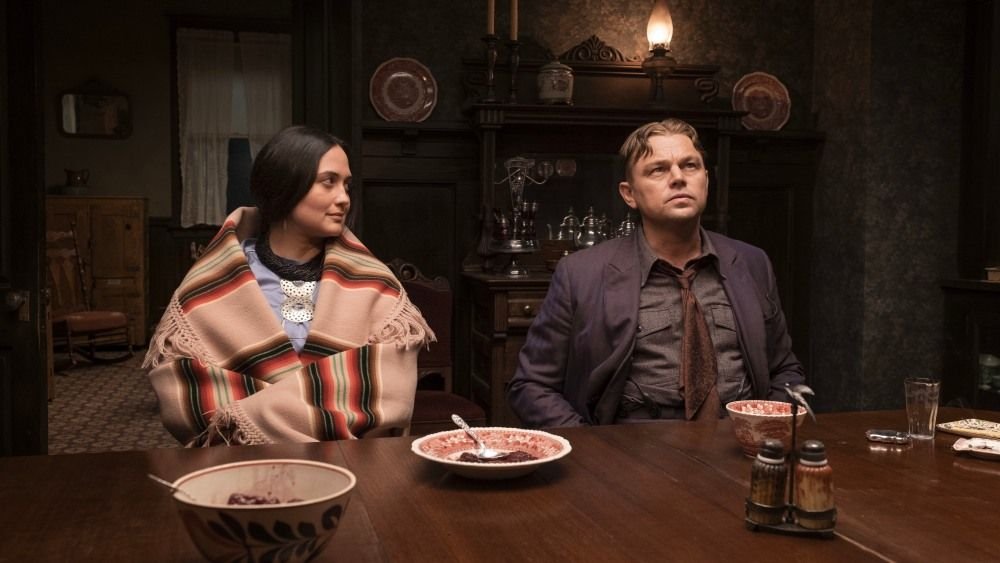
Episode 21: Killers of the Flower Moon (2023)
Guest: Wilson Pipestem
Listen Anywhere You Stream
~
Listen Anywhere You Stream ~

Killers of the Flower Moon (2023) describes the series of murders of members of the Osage Nation in Oklahoma in the early 1920s. Because tribal members retained mineral rights on their reservation, they became extraordinarily wealthy after oil was discovered on tribal land. This leads a corrupt local boss, William K. Hale (Robert De Niro), to conspire with others in the community to deprive the Osage of their wealth by murdering them. Directed by Martin Scorsese and based on the 2017 book by David Grann, Killers of the Flower Moon focuses on the plot by Hale and his two nephews, Ernest Burkhart (Leonardo DiCaprio) and Byron Burkhart (Scott Shepherd), to take the oil rights of one Osage family. Hale's scheme is for Ernest to marry one of the sisters in the family, Mollie (Lily Gladstone), and then kill her other family members before finishing off Mollie herself so that Ernest can inherit Mollie's headrights. Eventually, federal agents come to Oklahoma to investigate the murders and uncover Hale’s plot, saving Molly and uncovering evidence to prosecute Hale and Ernest. But this is only after many Osage are murdered and their wealth stolen in a chilling story of violence, greed, and the racially motivated devastation of the Osage Tribe. I’m joined by Wilson Pipestem, a partner at Pipestem Law and citizen of the Otoe-Missouria Tribe and an Osage headright holder, who has dedicated his career to protecting the rights of tribal governments and American Indians.

Wilson Pipestem’s career has been dedicated to protecting the rights of tribal governments and American Indians. Mr. Pipestem has represented and advised tribal governments on a broad range of issues from treaty rights to minerals production to gaming. Mr. Pipestem formerly practiced law at Swidler Berlin Shereff Friedman, LLP, a law firm based in Washington, D.C. Mr. Pipestem served as lead counsel in Osage Nation v. United States, a case in which the Nation alleged federal mismanagement of Osage mineral resources and the funds derived from minerals production. After eleven years in federal court litigation, the federal government and the Nation agreed to settle the case for $380 million, the largest settlement at the time of a single tribe against the United States. Mr. Pipestem has helped tribes reacquire lands lost as the result of misguided federal policies through both congressional enactment and administrative decision. He has helped tribes protect their aboriginal territories from encroachment, and successfully advocated for greater tribal control over tribal lands, water, and resources, as well as adjacent federal lands. In 2013, Mr. Pipestem played a prominent role in the enactment of the Violence Against Women Act reauthorization that reaffirms the inherent sovereign rights of tribal courts to exercise criminal jurisdiction over all persons who commit domestic and dating violence crimes against Native women. In 2004, he led the advocacy team that achieved congressional reaffirmation of the inherent sovereign right of the Osage Nation to determine its form of government and membership. Mr. Pipestem frequently speaks on developments in federal law and policy and has taught Federal Indian Law as a Lecturer at Columbus School of Law at The Catholic University of America and as an Adjunct Professor at Washington College of Law at American University. He is a citizen of the Otoe-Missouria Tribe and an Osage Headright Owner. Mr. Pipestem also is a Founding Partner at Ietan Consulting, a federal advocacy firm that also represents Indian tribes.
32:06 The level of local complicity in the Osage murders
33:55 The treatment of the Osage as “incompetent” under the law
38:33 Capturing Osage tradition and belief on screen
41:27 Mollie and Ernest’s complex relationship
45:50 How the Osage overcame a legacy of violence and impunity
48:50 The role of law and lawyers
51:58 How Martin Scorsese listened to and engaged the Osage people
0:00 Introduction
4:26 The historical context and Osage tribal rights
14:35 The stereotype of rich Osages
15:25 Legal trusts and exploitation of the guardianship system
22:17 How limits on federal and tribal jurisdiction led to violence and impunity
26:30 Fear and terror in the Osage community
29:48 The federal investigation
Timestamps
-
00;00;00;22 - 00;00;37;10
Jonathan Hafetz
Hi, I'm Jonathan Hafetz and welcome to Law and Film, a podcast that explores the rich connections between law and film. Law is critical to many films. Film, in turn, tells us a lot about the law. In each episode, we'll examine a film that's noteworthy from a legal perspective. What legal issues does the film explore? What does it get right about the law and what does it get wrong?
00;00;37;12 - 00;01;08;14
Jonathan Hafetz
How is law important to understanding the film? And what does the film teach us about the law, and about the larger social and cultural context in which it operates? This episode, we'll look at killers of the Flower Moon. The 2023 film directed by Martin Scorsese, based on the 2017 book of the same name by David Grann. The movie describes a series of murders of members of the Osage Nation in Oklahoma in the early 1920s, because tribal members had retained mineral rights on their reservation.
00;01;08;16 - 00;01;47;08
Jonathan Hafetz
They became extraordinarily wealthy after oil was discovered on tribal land. This led a corrupt local boss, William King Hale, played by Robert De Niro, to conspire with others in the community to deprive the Osage of their wealth by murdering them. The film focuses on the plot by Hal and his two nephews, Ernest Burkhart, played by Leonardo DiCaprio, and Byron Burkhart, played by Scott Shepherd, to take the oil rights of one Osage family by having Ernest persuade one of the sisters, Molly, played by Lily Gladstone, to marry him and then kill off of her remaining family before finally finishing off Molly herself.
00;01;47;10 - 00;02;11;01
Jonathan Hafetz
Ultimately, agents from the Federal Bureau of Investigation, the forerunner of the FBI, come to Oklahoma to investigate the murders and uncover Hale's plot, saving Molly and causing Hal and Ernest to be prosecuted. But this is only after many Osage are murdered and their wealth stolen, and a chilling story of violence, greed, and the racially motivated devastation of the Osage tribe.
00;02;11;03 - 00;02;33;28
Jonathan Hafetz
Joining me to discuss killers of the Flower Moon is Wilson Pipe. Stan Wilson is a partner at Pipe Stem Lore, a firm he founded in Tulsa, Oklahoma. Wilson's career has been dedicated to protecting the rights of tribal governments and American Indians. Wilson has represented and advise tribal governments on a broad range of issues, from treaty rights to mineral production to gaming.
00;02;34;00 - 00;02;58;20
Jonathan Hafetz
Wilson served as lead counsel in Osage Nation First United States, a case in which the nation alleged federal mismanagement of Osage mineral resources and the funds derived from minerals production. After 11 years in federal court litigation, the federal government and the nation agreed to settle the case for $380 million, the largest settlement at the time of a single tribe against the United States.
00;02;58;22 - 00;03;36;14
Jonathan Hafetz
Over his career, Wilson has helped tribes reacquire lands lost as a result of misguided federal policies through both congressional enactment and administrative decision. He has helped tribes protect their aboriginal territories from encroachment, and successfully advocated for greater tribal control over tribal lands, water, and resources, as well as adjacent federal lands. In 2013, Wilson played a prominent role in the enactment of the Violence Against Women Act reauthorization that reaffirms the inherent sovereign rights of tribal courts to exercise criminal jurisdiction over all persons who commit domestic and dating violence crimes against native women.
00;03;36;16 - 00;03;59;15
Jonathan Hafetz
In 2004, he led the advocacy team that achieved the congressional reaffirmation of the inherent sovereign right of the Osage Nation to determine its form of government and membership. Wilson is a frequent speaker on developments in federal law and policy, and has taught federal Indian law as a lecturer at Columbus School of Law at the Catholic University of America, and as an adjunct professor at Washington College of Law at American University.
00;03;59;18 - 00;04;14;28
Jonathan Hafetz
Wilson is a citizen of the Otoe, Missouri tribe and an Osage head right owner. He's also a founding partner at Eton Consulting, a federal advocacy firm that also represents Indian tribes. Wilson, it's an honor to have you on law and film. Welcome.
00;04;15;01 - 00;04;17;06
Wilson Pipestem
Thank you. It's my honor to be here.
00;04;17;08 - 00;04;25;28
Jonathan Hafetz
So can you tell us a little bit about the historical context for the events that are depicted in the movie, or is of the flower moon?
00;04;26;01 - 00;04;48;24
Wilson Pipestem
So let me tell you about some of the context, as I understand it from a local perspective. You know, my grandmother, Rose curd, Pipestone, lived in this area, Gray Horse and Fairfax, and when she was 16 years old is when the, murders began in that area were when Anna Brown was murdered. She was, a young lady in the community.
00;04;48;27 - 00;05;14;17
Wilson Pipestem
And so for people in the Gray Horse community where I'm from, where these, you know, general, these murders occurred, this history was sort of difficult for many reasons. One. You know, there had been great hardship that the people at that time had remembered. So if you think about where we come from, from there, I mean, the Osages had a large area over which they exercised authority.
00;05;14;17 - 00;05;49;06
Wilson Pipestem
Then, like many other tribes, that area got smaller and smaller by treaties with the United States. And as the Osage Nation became more depleted as a military power, we found ourselves at our last reservation in Kansas. And then there was encroachment on those lands. And, you know, additional treaties made clear that, hey, one of these days we may try to move you to the Indian Territory, which at the time was the thought that we're going to try to move everyone there because, we want them out of the way of kind of non Indian settlement.
00;05;49;06 - 00;06;11;21
Wilson Pipestem
So from there that's very common. You see a lot of tribes across the United States that entered into treaties. Their land bases got smaller, they were pushed westward. But then there's some very different elements of the Osage story as a legal matter and historical matter. The Osages, actually use their own money to purchase their lands. what's now the Osage reservation?
00;06;11;21 - 00;06;39;26
Wilson Pipestem
We end up purchasing from the Cherokee Nation, the lands that currently comprise the Osage reservation. And, it was different also in that while there was pressure, external pressure by the United States and non-Indian settlement and the failure of the United States to enforce against individuals who were squatting on Osage lands and causing conflict. The Osage you sent three men to look at the land, but now makes up the Osage reservation to decide, is this something we want to do?
00;06;40;00 - 00;07;03;01
Wilson Pipestem
So led by a man by the name of what I think, who my dad used to describe as a prophet, what I think. And these two men went to this land and they looked around. You know what they did. Exactly. And where they went, it's not clear. But they came back to the osages on the lands in Kansas and said, you know, there's something here that will keep our children and our elders from starving and so on.
00;07;03;01 - 00;07;22;22
Wilson Pipestem
That advice, the osages decide, okay, we are going to make this and it's going to be our last move. We're not moving again. We're going to agree to this purchase of this land and move to this land that's in the Indian territory. So they made that decision to buy the land and to make this our last homeland. And that's where our homeland is.
00;07;22;22 - 00;07;45;25
Wilson Pipestem
It's where I live today. You know, from there on, Osage is moved to the present Osage Reservation. And they settled on these lands based upon the band and the band chiefs from which they were part of at the time. So a number of those band chiefs decided we're going to settle near Gray Horse, including Mohican Moye, who I'm descended from, or our families, a part of them.
00;07;45;25 - 00;08;07;18
Wilson Pipestem
One week of my band, from there, there were other full blooded band chiefs and decided, we're going to go to an area in Harmony, Oklahoma and create our home there. And then others created their home here today. That's more how we're organized is by district. Somebody says, where are you from? You have another Osage, you might say, or probably say from Gray Horse or home near from Husker.
00;08;07;24 - 00;08;32;01
Wilson Pipestem
And, where's your family from? You probably don't identify by district and then with more explanation. So that is where we get to this situation in the 1920s. So the Osages arrived in to the New Osage Reservation, and, there was this enormous external pressure from the United States to a lot of the Osage reservations, which was the federal policy at the time.
00;08;32;09 - 00;08;55;07
Wilson Pipestem
You know, we're going to try to get rid of all elements of Osage or, you know, tribal cultures and languages. And also we're going to try to open reservations up for non-Indian settlement through allotment, which is to say we're going to survey the lands and individual tribal members or tribal citizens would get portions of that land. And then we're going to work to try to encourage them to become farmers.
00;08;55;12 - 00;09;28;03
Wilson Pipestem
That was sort of the federal policy at the time. So allotment came with a lot of discussion among the Osages. Generally speaking, the full blood osages were more opposed to allotment. They wanted to keep the lands held in tribal ownership. The more mixed blood osages were more in favor of allowing allotment to move forward. And then there were efforts by the there's evidence that the superintend of the Bureau of Indian Affairs, Osage agency, would allow people to be included on the role of Osage just based on where they were for or against allotment.
00;09;28;03 - 00;09;51;07
Wilson Pipestem
So if a person said, hey, I'm a Osage and a Bureau of Indian Affairs agent said, well, are you for or against a lot? And so I'm for it. Okay. Then your I'll include you. Right. So there is enormous external pressure to try to get individual osages to agree to a lot, but which ultimately they succeeded. In 1906, the Congress said, okay, we're going to a lot to Osage Reservation, but we're going to make changes here.
00;09;51;07 - 00;10;13;05
Wilson Pipestem
We're going to create a unique system because of what we're hearing from Osages. So the tribal leadership at that time thought to say, okay, there's some evidence there may be, you know, oil or other minerals in the land. So Congress said, okay, we will keep the subsurface minerals state in ownership of the tribe itself, the broader sovereign tribe.
00;10;13;05 - 00;10;36;22
Wilson Pipestem
But the individual osages will receive the right to receive the money from the proceeds from minerals production. And the United States will manage that system, because at the time, Osages weren't citizens, they were presumed to be incompetent and inferior. But we're going to keep this system in place for a period of time, and it's going to expire. And then what?
00;10;36;23 - 00;11;03;13
Wilson Pipestem
This is all going to go away. This is all 1906. So the context, historical context includes that legal history of coming to the Osage reservation and then facing this external pressure of allotting the land, protecting the mineral estate under a single tribal owner. But the individual Osage would get the proceeds of the minerals. So that was the system that was put in place in 1906.
00;11;03;13 - 00;11;25;06
Wilson Pipestem
Here in 2024, that essentially that same system is in place today. It's been changed in some ways through amendments to the Allotment Act. But that same trust system, the only hybrid trust system in the United States involving a tribal mineral estate held in trust by the United States for the Osage tribe and then individuals getting the proceeds from that.
00;11;25;09 - 00;11;57;21
Wilson Pipestem
So they created a role of all the Osage, as they were 2229 of them. And so these individual osages will get the proceeds of the mineral estate. They thought, well, what are we going to do if one of the osages passes on? Does that mean there's just one less person that will receive a distribution of funds from the mineral state, or are we going to treat that individual as property after they pass on so the heirs receive the money, and so eventually the individuals were treated as property.
00;11;57;21 - 00;12;22;08
Wilson Pipestem
It's a right to receive the funds, but that can be inherited by the individuals who are heirs. Now, the Bureau of Indian Affairs, United States, made a really serious, serious mistake which was allowing non Indians non osages to inherit this property. Right. And that was the part that led to the events that are depicted in killers of the Flower Mound.
00;12;22;11 - 00;12;45;02
Wilson Pipestem
In other words, if you're a non-Indian, you can marry an Osage and if that Osage is killed or passes on or otherwise ends up in a probate or in a will situation, the non-Indian can inherit fully that property. Right? So what you see in killers of the Flower Moon, focusing on the person of Molly Burkhart, a full blown Osage and incompetent.
00;12;45;02 - 00;13;09;29
Wilson Pipestem
That's the first word she says. I think in the film she introduces herself and she says, Molly Burkhart incompetent and incompetency was a status. It meaning you're a half blood Osage a more right so entirely racist situation. Your incompetence and your inferiority is based on how Osage you are. If you're really, you know, a lot Osage by blood, you're presumed to be an incompetent.
00;13;09;29 - 00;13;34;07
Wilson Pipestem
Therefore, you need a white guardian to help you manage your affairs because you're just not able to do it. There's a lot more complicated context in there, too, but as a summary of it and how the Osage is came from our Aboriginal lands to Kansas and to the lands we're in today, and how we have this person of Molly Burkhart and kind of what happened to her and her family as a part of this story.
00;13;34;10 - 00;14;02;00
Jonathan Hafetz
That context is so important to understand and kind of just horrific to hear the manipulation of them. Thinking is, you know, you have the effort that was with the Osage and with other tribes to end their traditional tribal way of life and kind of force them into the system of private ownership. And then the Osage have the foresight, as you explained, I think, to negotiate for owning the mineral rights, for the rights for below the surface, suspecting there might be oil.
00;14;02;00 - 00;14;35;11
Jonathan Hafetz
And then, lo and behold, there is and there's maybe more oil than anyone had anticipated, and they become wealthy. And then in the movie, there seems to be a mix of using legal and extralegal means to deprive the Osage of their property. The legal means, I think. I guess it's the system of guardianship where it's the managing of the affairs, and then through the inheritance rights that could be obtained if a non Osage marries in Osage and they might be able to inherit the head rights, and that opens the door or creates the opportunity, if you will, I guess, for the exploitation through the violence that we see in the movie.
00;14;35;13 - 00;14;54;14
Wilson Pipestem
Well, let's start first about the premise that the Osage were wealthy. You know, some of these things that say the richest people in the world. So in the book killers of the Flower Moon, it says that I think the value of a head right at the height of minerals production in 1920s, and I think $2,020 would be about 400,000 head right, something like that.
00;14;54;17 - 00;15;14;21
Wilson Pipestem
Well, that's a whole lot of money. But that is not you know, there's some of these depictions, like each Osage was like one of the princes of Saudi Arabia. So if you think about 400,000 a year, like I said, that's a lot of money. But that's not the sort of generational wealth we see in other places. So rich Osage became a stereotype.
00;15;14;24 - 00;15;35;13
Wilson Pipestem
So I want to be careful to say that Osage is making a lot of money. And they were some of them were using spending their money in a profligate ways. But I just sometimes think that's a bit overstated. So then the legal and extralegal ways that Osages were separated from their rights, that's the the sad thing is, until you get to murder, most of it is not extralegal.
00;15;35;13 - 00;16;09;14
Wilson Pipestem
You have which in the case of a guardian and an Osage, you have a trust that's created a legal trust. And there were some actions brought by Osages against their guardians for making decisions that were not in the interest of best interest of the Osage individual, but there was so much corruption associated with it that some of the evidence shows that if you're an Osage in that era, and somebody passed on and you want to have a funeral for them, and you went to the funeral home and you wanted to get a casket, and you wanted to have a service, and you wanted to do things that we would have today for a funeral,
00;16;09;17 - 00;16;34;03
Wilson Pipestem
that in today's dollars that would cost about $80,000 for that Osage person to have a proper burial ceremony. So what you had was this network of guardians who not only worked for, had this trust relationship with an individual, but they themselves were the owners of the stores and the funeral homes, and even sometimes the persons who were the guardians, they were siblings.
00;16;34;08 - 00;16;59;13
Wilson Pipestem
So if they say, okay, I just paid the bill invoices. I was given the invoice in today's dollars for $80,000. I just paid my brother and his company who does a funeral home $80,000. And so there wasn't much enforcement. the trust obligation of the Guardian to the Osage ward. So at some point, that is a legal relationship as well, where the Guardian supposed to act in the best interest, the Osage.
00;16;59;13 - 00;17;18;25
Wilson Pipestem
But there's a lot of evidence that that wasn't happening in it, but it was pretty radically corrupt system. So there is a legal relationship there and there's ways to enforce it. But the question then, where do you enforce that and whether or not at the time an Osage adult was not a citizen of the United States, they were presumed to be incompetent.
00;17;18;29 - 00;17;37;19
Wilson Pipestem
It was wearing on those individuals. You know, in my mind, some of them, it had to have worn on them that everything we're hearing from these institutions about who we are as being lesser and no good, and we need to change. I think that wore on some Osage people to say is that maybe there's something wrong with us.
00;17;37;25 - 00;18;03;14
Wilson Pipestem
Maybe there's, in this new white man's world, we're lesser people, and I just don't know that. But I certainly feel like, that must have been heavy on many. Osage. Is this specific Osage guardianship relationship and nonsense. And she had been through boarding school. So they were told all of the federal boarding schools or religious institutions backed by the federal government saying, hey, everything you've been taught, that's good.
00;18;03;14 - 00;18;25;28
Wilson Pipestem
Ways that you pray, ways that you celebrate, ways that you carry on your life even though you believe their creator or given are no good. All those things you've been learned, that's just, you know, you've been deceived every way you've gotten by over time. And no matter how perfect you see it, because it's creator given, it's not.
00;18;26;01 - 00;18;52;08
Wilson Pipestem
And we're going to try to instill that view of it not being good through your children, the adults who may not be able to get them, but we're going to take your children away from you and teach them Osage. At the time of the story, we're still going through all of that. We were still in this period of time where there was enormous external pressure from various institutions led by the federal government, that all these things, you know who you are or you don't don't believe those things that you had.
00;18;52;08 - 00;19;19;18
Wilson Pipestem
Osage, as some of them were, said, hey, we have to survive in this world. So let's go with that. And then others who were just directly resisting that and saying, hey, if this is creator given, how can it be imperfect? How can it be wrong? But there was, you know, created enormous conflict among Osage people. And so you have to think about the traumatic institutional pressure that was weighing on osages at that time and continues today.
00;19;19;24 - 00;19;42;17
Wilson Pipestem
And it started before, you know, Molly Burkhart was born around the time Burkhart was born. But these external forces trying to say, you are inferior, your institutions and your beliefs are inferior, and you need to stop doing them. And we're going to try to coerce you into that. So that's part of the context. But that's also the legal context in which you're operating.
00;19;42;17 - 00;20;00;22
Wilson Pipestem
Is that now you've got a non-Indian person saying, you know, you got to check with me before you decide you want something. So at our home in Sky two, Oklahoma on the Osage Reservation, we have a piece of furniture that belonged to my grandmother Rose. And on the back of it it says a US ID, which stands for the United States Indian Department.
00;20;00;26 - 00;20;23;10
Wilson Pipestem
And if she wanted something like that piece of furniture, he had to convince somebody else that she needed it. And then it came through the Bureau of Indian Affairs, and they branded it, or they decide. So it came through them as a way of controlling, how individual osages could spend their money. So some of these ways that Osage spend their money on vehicles are the thing.
00;20;23;10 - 00;20;50;09
Wilson Pipestem
I mean, to me, that's sort of should be up to them. But under this legal system, something as simple as a piece of wood furniture had to go through. A Guardian goes to the Bureau of Indian Affairs for some sort of approval in the use of her own money. The legal institutions of the time are portrayed somewhat in killers of the Flower Moon, but abroad our understanding of what was going on at the time kind of gives you a sense of why non-Indians thought we can kill them with impunity.
00;20;50;09 - 00;21;04;07
Wilson Pipestem
We just got to hide out a little bit. We can't let anybody know. We can't do it in light of day. The amounts of money are significant, and so we can't expect that. If there's a lot case against us in Osage County Court that we'll ever be convicted. So why not do it.
00;21;04;09 - 00;21;24;07
Jonathan Hafetz
So important to sort of understand that and what you're describing in kind of creating this sense of impunity for people like Hal in the movie, Robert de Niro character who's the ringleader of the conspiracy and everyone else to exploit and then ultimately start using violence. I'm, you know, I'm recalling from the movie, Hal is only sort of chided when he goes like a little bit too far, right?
00;21;24;07 - 00;21;50;06
Jonathan Hafetz
It's like too obvious. So when they view when they set the explosive that kills one of Molly's sisters and her husband, it's just too much. But it allows for this other quite extreme violence and exploitation to occur. And also, I you know, I'm thinking back to the movie too, when you talk about the control and forced dependency, that there's that scene where Molly decides is after at least one or more of her sisters has been killed, she's starting to feel sick from the poisoning of her for treating her diabetes.
00;21;50;13 - 00;22;04;10
Jonathan Hafetz
She feels like she this is her last year is going to go to Washington and try to appeal to the federal government, and she has to ask her guardian to please allow the trip. It's just going to be wasteful and not going to do it. But she ultimately persuades her. But it kind of just goes to your point.
00;22;04;12 - 00;22;29;15
Wilson Pipestem
Yes. You see, what was happening was this system of control not only to the Osage Nation as a government, but not individual. Osage has enormous levels of control that I think are even unique among tribes. But also one legal issue really important in all of this is that the Osage reservation was created. It was reaffirmed by statute and called a reservation, the linchpin of the FBI coming in.
00;22;29;21 - 00;22;51;23
Wilson Pipestem
So Jesse Plemons and, you know, J. Edgar Hoover deciding something has to happen here was the fact that Henry Roan was murdered on a federal trust allotment, meaning an individual Indian owned the land. It was still held in. maybe it was in restricted status. So that created this notion that, okay, now we have the feds have jurisdiction here because it's on a trust allotment.
00;22;51;24 - 00;23;31;20
Wilson Pipestem
Well, sadly, if the United States would have treated the reservation as, Indian country as it certainly was and still is today, then any of these things would have been federal jurisdiction to start with. You know, there would have been broader opportunity to get away from just local government, like if there was an Indian involved in a crime, there would have been more leverage for the authorities, federal authorities to do so today if there was a non-Indian who was a perpetrator and the victim is Indian by the federal jurisdiction at the time, in the 1920s, I believe it was still the law, as it is today, that a crime committed by a non-Indian perpetrator against
00;23;31;20 - 00;23;57;28
Wilson Pipestem
the Indian would be federal jurisdiction. So that presumes where is the land? If it's on a reservation, then it's federal. If it's not, then you know it's left to the local county court. It was generally a sense that a non-Indian was not going to be convicted in Osage County Court today, the Osage reservation, there's a decision called Irby out of the 10th Circuit that says the Osage reservation was destroyed.
00;23;58;00 - 00;24;20;01
Wilson Pipestem
Now, if you look at the case, McGirt, the McGirt case that reaffirmed the Muskogee Creek reservation, basically, McGirt said, you know, the U.S. Supreme Court said through Justice Gorsuch opinion that you have to look at the language that created the reservation and then supposedly disestablished it, and it has to be disestablished in clear language. And Congress has done that.
00;24;20;01 - 00;24;41;02
Wilson Pipestem
They have this established reservations. If you look at what Irby said, which was decided before McGirt, the 10th Circuit said, well, we don't find any language in this establishment in the statutes. So we're going to go to an alternative analysis under a case called sodomy. And we find it was the reservation was disestablished. Well, the Supreme Court has since said, you can't do that.
00;24;41;05 - 00;25;06;26
Wilson Pipestem
You have to find some statutory disestablishment of the reservation. Well, if the Osage reservation was in existence at the time and it was as a legal matter as it is today, then there would have been more opportunities for federal jurisdiction and tribal jurisdiction over those lands, and there wouldn't have been just this belief by non-Indians that your criminal activity was, you know, you had to be careful because you could still get in trouble.
00;25;06;26 - 00;25;43;28
Wilson Pipestem
But, you know, we like our chances with kind of just keeping it local here. So again, the legal context that allowed these sort of this sort of violence to occur on Osages was significant. Now the Osages, I think they were saying, if we can find and we'll kill them ourselves, we will kill these people ourselves. But they couldn't find them because people like William Hale were so integrated into Osage society, and they had ingratiated themselves and had been particularly devious in the way that they created friendships and relationships over years and years, even leading to marriage, intermarriage.
00;25;44;00 - 00;25;54;18
Wilson Pipestem
The Osages, I'm confident, would have killed all of the perpetrators themselves. But the problem and the need for law enforcement was identifying who was doing it.
00;25;54;21 - 00;26;19;03
Jonathan Hafetz
I think the film does a good job of showing how, William King hail King, right? Robert De Niro character, how he integrated himself or grace himself in the Osage community, was looked as a kind of local benefactor, even as he was plotting to take the land and to murder so many people. There's also that great scene in it was a meeting of members of the tribal Council and how in the old days, the leader says, we found traitors.
00;26;19;03 - 00;26;25;12
Jonathan Hafetz
We'd have killed them. But now it's almost like they don't know who it is or how to respond.
00;26;25;14 - 00;26;49;18
Wilson Pipestem
Which must have been kind of, an intense way or a heavy way to be living in that community. And I'll tell you, some survivors, you know, my dad was a lawyer, kind of celebrated lawyer, and was lead counsel on some seminal cases in Indiana, on Oklahoma, and was counsel to the Osage tribe. Now the Osage Nation. And he dragged me along to court, and he dragged me along to Osage tribal Council meetings, other things he was doing.
00;26;49;21 - 00;27;09;10
Wilson Pipestem
But my grandmother, Rose Pipestone, his mother, when she would get me separate for him, she would say, don't follow your dad into that world. ultimately, I went with my dad. I didn't go with my grandmother. I didn't understand it. My grandmother and my dad had a very close relationship. I mean, all of that. But she would get me apart from him and say, don't try to go to law school.
00;27;09;10 - 00;27;39;20
Wilson Pipestem
Don't be a lawyer. Don't get involved with the Osage tribe. And she would say, somebody is going to do something to you. And I never understood that until I read killers of the Flower Moon, the level. fear and trauma that people like Rose Pipestone went through as osages who lived through that time, who were vulnerable to violence and experienced violence directly, and what trying to do something about it could mean for themselves or their families.
00;27;39;20 - 00;27;58;17
Wilson Pipestem
And so that's what she told me, said, somebody is going to do something to you if you do what your dad's doing. I understand now he was trying to protect me, but it was a, I think, a way that her trauma was playing out in me. She saw that I was going along with my dad. My dad was training me from as a child to be an advocate.
00;27;58;22 - 00;28;20;04
Wilson Pipestem
And like I say, I got dragged along to court and meetings. I didn't want to go, didn't understand it, but my dad used to say, trying to create a place in your mind to put things related to these issues. So I'm always thankful to my dad, who passed on in 1999, that he was that he did that for me, with which just to try to create some place in my mind to learn about these matters of Osage government.
00;28;20;06 - 00;28;40;03
Wilson Pipestem
And I benefit significantly from him doing that. But if you understand the rules, Pipestone World and the Molly Burkhart world and the level of fear and terror they suffered, and in some cases some of these families, just the direct loss of life and devastation of the family and relatives, then you kind of understand about what our Osage people today are still working through.
00;28;40;05 - 00;29;00;07
Jonathan Hafetz
The trauma and the intergenerational trauma is just so significant. I mean, the Osage refer to this as this reign of terror, right? I mean, the amount of Osage who were killed, murdered, violent or suspicious deaths. There were at least 24 starting in 1921. But then I described, I think, particularly in the book, there's evidence it was many more.
00;29;00;07 - 00;29;09;02
Jonathan Hafetz
I mean, a community of this size, relatively small. I mean, you mentioned before the tribe was just over 2000 people. I mean, it's mind boggling. And the fear that must have caused.
00;29;09;05 - 00;29;29;12
Wilson Pipestem
You know, and Gray Horse were the smallest of the three districts or relatives, Muhammad in Pawhuska. And we're the most remote. So the trauma that was created by this area and all they were going through, two that wasn't directly related to the murders, it was a hard, hard time. And so Osages were doing their best. Some of them left, you know, they just moved to California.
00;29;29;12 - 00;29;48;08
Wilson Pipestem
Right? I got to get out of here where they sent their children off to military school or something else to try to not be subject to this sort of violence. So Osages were doing their best to deal with a circumstance of disempowerment, violence, and just attack on who they are as people.
00;29;48;11 - 00;30;05;20
Jonathan Hafetz
The federal government gets involved kind of late in the game, right? And only after, as the book depicts, of Molly or the movie Molly goes to Washington, pleads with Calvin Coolidge directly. Was it more the federal government was sort of constrained by jurisdiction, or there was just not so much. It just wasn't really that important given prejudice at the time.
00;30;05;20 - 00;30;07;18
Jonathan Hafetz
It wasn't just a high priority.
00;30;07;21 - 00;30;34;11
Wilson Pipestem
So I'm not sure about the historical facts of that. That's my understanding, is there is evidence that Molly Burkhart went to Washington, D.C. to advocate for justice. My great grandfather, Wilson Kirk, was one of the chiefs that went to Washington, D.C., to advocate for justice. And so their reaction, I think the answer is that the hook for federal involvement was the murder of Henry Roane on lands within the reservation that were held in trust or restriction.
00;30;34;11 - 00;30;53;17
Wilson Pipestem
So that would have been federal jurisdiction. That's why they could say, hey, it's we can now come in and fully investigate this. But you're also talking about a new FBI with a new director. And so I don't think if there would have been 1 or 2 murders, they would have they might not have come in. But at some point, there was an effort to finally say, we need to go do something about this.
00;30;53;17 - 00;31;13;12
Wilson Pipestem
And there's also evidence that J. Edgar Hoover, I think, if I'm recalling correctly, was saying, hey, we got to get this right, or we may lose our funding for our agency because we're in such a nascent stage here that we need to go get these Osage murders, right. Once they were able to get convictions, they celebrated it through these Lucky Strike shows and that were FBI funded.
00;31;13;12 - 00;31;24;25
Wilson Pipestem
That's depicted in the film, which my understanding was really happened that, you know, they did these shows where they celebrated themselves and their kind of good works to build community support for their public support for their agency.
00;31;24;28 - 00;31;45;23
Jonathan Hafetz
The book, I think, places more emphasis on this other narrative of the FBI than the Bureau of Investigation, which was a relatively in a fledgling or much smaller group that hadn't come into the status and the power that we know of the FBI today, and that this was kind of a critical, almost like make or break case for the FBI, sort of maybe obliquely hinted at in the movie, but it's more of a focus of the book.
00;31;45;23 - 00;32;06;04
Wilson Pipestem
Yeah. That's right. I mean, but I think that's what happened. You know, the federal government has an obligation as federal trustee in these circumstances. They assume certain responsibilities that now, generally speaking, they have not historically carried those out very well at all. But I do think as a jurisdictional matter, that was the hook that there was, it was on federal trust land or restricted land.
00;32;06;06 - 00;32;27;14
Jonathan Hafetz
The movie really focuses on how the Robert De Niro character is that mastermind of or behind a lot of the plot, but I think the film suggests so many people in the town, in the area of the non-Indian population, were involved, like the doctors, the two doctors who signed on to slowly poisoning Molly when they, you know, she had her diabetes.
00;32;27;14 - 00;32;41;26
Jonathan Hafetz
And so in treating this, they were basically allowing her to be poisoned to death or attempting to poison her to death. I don't know if you could just talk about what that was like, because it wasn't just a it was certainly a handful of particularly bad apples like Hale, but it was really fairly widespread, it seems.
00;32;41;29 - 00;33;06;11
Wilson Pipestem
You think about in our lives today, your life today, mine, and having a family or just trying to take care of yourself. Part of the institutions that you rely upon are doctors. Like, I'm not feeling well. Like if something's going on, I have to go. And you have an expectation of competence and them acting in your best interest and not being able to trust that because you just didn't know.
00;33;06;11 - 00;33;35;18
Wilson Pipestem
Now I go to see my doctor. I had great trust in him, but I don't have any, you know, the suspicion that he's actually trying to kill me with the medication update, right? But imagine being in a time where the doctors are actually in on the conspiracy to. They're one of the institutions of life, you know, doctors in our community, and they have obligations, but somehow that they're part of the conspiracy to that can, you know, lead to them getting more money, but lead to the more quick demise of a human being?
00;33;35;20 - 00;33;54;01
Wilson Pipestem
That's kind of a hard thing. You know, you got bad actors out there who kill people, and there's people who do heinous things in society. We don't always expect that's going to be doctors who are carrying these things out. And so it's hard for me to put my mind around society at that time that could devalue these lives.
00;33;54;01 - 00;34;16;11
Wilson Pipestem
Now, let me tell you, my grandmother, Rose Pike's name was a brilliant person. So the idea that somehow she was in fear or incompetent is so kind of antithetical to my understanding of who she was and things that she could remember and things that she could think and talk through, that she was sort of the very opposite of that of an inferior in my mind.
00;34;16;11 - 00;34;41;12
Wilson Pipestem
She was among human beings, a superior intellect. Today, the idea of inferiority or incompetence under the law. So right now, if you're a half blood or more Indian, including Osage, you're still an incompetent under those existing laws today, which include myself and my children. Now, it doesn't have the hard consequences that it did my grandmother's era in the Mollie Burkhart era where we have to have a white guardian.
00;34;41;13 - 00;35;09;16
Wilson Pipestem
It doesn't have those sort of hard consequences, but it still makes some judgments on, you know, the kind of policy behind it at least started with these sort of inferior beings here. These are inferior people. And that's not a political statement. That's sort of the legal status as an incompetent. You know, we say non compos mentis today of somebody who can't, you know, so you've got a very elderly relative that suffers from dementia, or you've got other people in society where somebody else makes a decision for them.
00;35;09;16 - 00;35;37;14
Wilson Pipestem
They sort of treat it like them as that. That's the default is they're like that. And so you're talking about an Osage society that had business people and spiritual leaders and artists and kind of the things that make society go and be healthy. The Osage has had all those things. We had artists and business people and spiritual leaders and, you know, people of enormous not only competence but significance and ability, you know, athletes.
00;35;37;14 - 00;36;11;03
Wilson Pipestem
But it was just they're Osage. So we're going to treat them like they inferior. And, you know, it wasn't till later in that era where they became citizens of the United States. So for me, in the life I've lived with, you know, the protection of my parents and grandparents and growing up and being able to go to school and not being constantly barraged by the idea that we're lesser people and protecting my children against those ideas that are things that we've been taught that are good, that are creator, given, that are somehow lesser, we push back against that notion in some case, litigate against that notion.
00;36;11;03 - 00;36;40;06
Wilson Pipestem
But it's hard for me to understand that level of harm that Osage human beings went through during that time where they were so labeled and had institutions pounding away at them all the time about us. So it's pretty remarkable to me that our community has continued to persevere and resist it. It certainly took its toll. But there were resisters like Rose curd, Pipestone and said, you know, these things we were taught if they're creator given, how can they be lesser?
00;36;40;06 - 00;36;56;23
Wilson Pipestem
So I'm not accepting that. We're not accepting that. And even said in the book, David Grant's book, he says, looking at one of the federal reports, they say, you know, we're trying to assimilate the osages. We're trying to get rid of Osage culture and language. And some of the men are going along. It's the women that are resisting.
00;36;56;23 - 00;37;20;09
Wilson Pipestem
So our communities had people like Rose Pope stem and, you know, Molly Burkhart and others that were resisters to that idea. Now, did they go along and have driving cars? Of course, you know, the era at the time and they were blankets and they do things that took advantage of European created things or Western ideas. They did. But that doesn't mean the core who they were.
00;37;20;11 - 00;37;45;15
Wilson Pipestem
They resisted the notion that they were the lesser. We are the children and grandchildren of those resisters that today can say we can. Things we have about the ways we pray and the ways that we conduct ourselves, and how we see the elements and the ways that we honor want each other or others. All those things that we're told were just absolutely inappropriate or even unlawful.
00;37;45;15 - 00;37;56;29
Wilson Pipestem
When we dance and sing and celebrate that those things are we now believe are good and we're kind of digging our way out of that era, we're doing our best to try to come out of that era.
00;37;57;01 - 00;38;15;19
Jonathan Hafetz
What you're saying about Molly Burkhart, the film, I think, really brings out to life someone who was resisting. She was, well, open to aspects of modernity. You know, she has the car. That's how Ernest Burkhart, the Leo DiCaprio character, meets her, raised her basically a taxi driver, a chauffeur. You know, she takes advantage of those things, but she wants to maintain and traditional ways.
00;38;15;22 - 00;38;33;17
Jonathan Hafetz
There's that scene between them when it's it's under storm and she wants to leave the window open, a sort of part of a longstanding belief system and resist. I mean, she's the one that goes to Washington to try to make the plea. So, yeah, I thought she really embodied what you were saying in terms of those kind of complexities and being kind of a very rich character.
00;38;33;19 - 00;38;44;28
Wilson Pipestem
You brought up the scene when it's storming outside, and Leonardo DiCaprio character, you know, starts to go out the window and she tells him, leave that open. It's time to just sit still.
00;38;45;01 - 00;39;08;04
Killers of the Flower Moon Dialogue
No, no, don't close it. What? We need to be quiet for a long. Storm. It's a it's powerful. So we need to be quiet for a while. It's good for the crops, that's for sure. Just be still.
00;39;08;06 - 00;39;26;26
Wilson Pipestem
And you described it in a way that what you saw is that. What is this about? Why did that happen? Maybe there's some cultural reason for that, but I don't know what that is. But let me tell you. So my grandmother Rose used to say when I was a boy, when it would storm, she would say, we have to just sit quiet and I'll turn everything off.
00;39;26;26 - 00;39;44;16
Wilson Pipestem
If you've got the TV on or radio on and it's time just to sit still. And so that's what we did. And finally I asked her, why don't we do that, grandma, what is it that we do that? And she said that, you know, these elements belong to work under that's God. These elements are his and they're powerful.
00;39;44;23 - 00;40;12;17
Wilson Pipestem
And a heavy storm like this. If we were just to act like nothing was going on and these elements are in place or there's something happening and we just went on with our daily lives, like, this is not some sort of power, expressed through elements. Something might happen to us. So that's a time to sit still and pray and just, you know, acknowledge that we have a creator that's powerful and that these elements belong to the creator.
00;40;12;19 - 00;40;36;26
Wilson Pipestem
And so I think what I see that scene in killers of the Flower Moon, I think that's Martin Scorsese and Lily Gladstone hearing and understanding part of Osage tradition and belief and putting it in there for us. That's for the osages to to see and understand. And so the fact that you brought it up is saying, wait a second, this is why would she do that?
00;40;37;00 - 00;40;56;08
Wilson Pipestem
And I don't necessarily understand what that is. But for me, when I saw that, that's what I thought. And Molly Burkhart is saying, it's a way of resisting. I've got this white guy in my house who's what, due to random things my way, based on my spiritual and traditional beliefs. And when you're in my home, we're going to adhere to that.
00;40;56;11 - 00;41;18;14
Wilson Pipestem
And when there's a heavy storm, it's a time to sit still. It's just a time to sit still and be respectful. So I believe that Martin Scorsese, you heard The Osage is there and put that scene in the film. And I believe that Lily Gladstone had a role in that. And saying, this is for the Osages don't understand that.
00;41;18;16 - 00;41;39;24
Jonathan Hafetz
I thought it was such a powerful moment in the film, and I think that's wonderful that it was sort of included in the film. I felt it was just a really great moment. I want to ask you a little bit more about the relationship between Ernest Burkhart, Leo DiCaprio, Emily Burkhart, Lily Gladstone. That was certainly part of the book, but the movie places that relationship kind of at the center.
00;41;39;24 - 00;42;01;22
Jonathan Hafetz
And as I understand it, that was a deliberate decision by Martin Scorsese, I think in conjunction with, you know, DiCaprio to center that relationship or to make that relationship the center of the film. So I wanted to ask what you thought about that and also about the Ernest Burkhart character. He's a bad person and he's done many bad things, but he's not the sociopath that al is who just seems like a complete sociopath.
00;42;01;22 - 00;42;13;10
Jonathan Hafetz
But he does love Molly, it seems, even as he has participated in killing her family and is one of the people slowly poisoning her. So I just love to hear your thoughts about the relationship and about his character.
00;42;13;13 - 00;42;34;20
Wilson Pipestem
Ernest Burkhart was a real person and he was married to a real person, Molly Burkhart, Molly Kyle Burkhart, and they were married and they had several children. And one of the criticisms I've seen of the film was that there's no way he actually loved her, because he did these things right. That's been one of the criticisms of the film.
00;42;34;22 - 00;42;53;18
Wilson Pipestem
But I can tell you, there was a time when our gray horse people met with had a dinner and Mr. Scorsese, you there. Nine other people from the film were there, and the granddaughter of Molly and Ernest Burkhart was at the dinner, and she initially was not wanting to talk. And then she said, no, I do want to say something.
00;42;53;20 - 00;43;14;14
Wilson Pipestem
And one of the things I remember her saying is that something like this, you'll never get me to believe that my grandparents didn't love each other. So in my view, Scorsese had that question how do we depict Ernest? Do I listen to those who might say he was such a no good son of a gun? There's no way he loved her.
00;43;14;14 - 00;43;24;07
Wilson Pipestem
This was all just in the population. Or do I listen to the granddaughter of the actual Molly Burkhart? And Ernest worked hard to believe wherever it started and end up in a loving marriage.
00;43;24;09 - 00;43;32;01
Jonathan Hafetz
Here's the initial scene between Molly and Ernest, where you can see some of the feelings between them.
00;43;32;03 - 00;43;34;09
Killers of the Flower Moon Dialogue
He told me he was he was going with.
00;43;34;09 - 00;43;36;25
Wilson Pipestem
Matt Williams for a time.
00;43;36;28 - 00;43;39;15
Killers of the Flower Moon Dialogue
You talk too much.
00;43;39;18 - 00;43;45;23
Jonathan Hafetz
I don't talk too much. Just thinking. Well, I got a beat in this horse race. That's all.
00;43;45;26 - 00;43;50;13
Killers of the Flower Moon Dialogue
I didn't realize it was a race. I don't care for watching horses.
00;43;50;15 - 00;43;53;05
Killers of the Flower Moon Dialogue
Well, I'm a different kind of horse.
00;43;53;07 - 00;44;03;06
Killers of the Flower Moon Dialogue
I did confess she showed me. She asked me what was it? So make us see. That's how you are.
00;44;03;08 - 00;44;05;05
Jonathan Hafetz
I don't know what she said, but must have been.
00;44;05;05 - 00;44;06;23
Wilson Pipestem
Indian for handsome devil.
00;44;06;25 - 00;44;11;01
Jonathan Hafetz
She was.
00;44;11;03 - 00;44;32;05
Wilson Pipestem
Now, ultimately, that marriage ended up in divorce because I think he believed him until he actually testified that he was involved in it. And that's when she left the marriage and divorced him. But I think it's hard for some people to understand how complicated marriage can be, particularly where you had a white man and a Osage woman who was in such a disempowered situation.
00;44;32;08 - 00;45;06;24
Wilson Pipestem
And I think William Hale was depicted, appropriately, as sort of the ringleader, and this was his kind of weak nephew who was going along. But I believed Margie Burkhart over the critics. I think she should be listened to when it comes to that relationship, and that it was appropriate to depict this as a marriage that included as a part of its complicated story, that that he loved her, had children, you know, they had three children together, but in the telling of this story, I believe the Burkhart family or the Osage family or the critics.
00;45;06;26 - 00;45;23;05
Jonathan Hafetz
And I thought the film was compelling and showing how Molly was conflicted and how she could still love him in spite of what had happened. And, you know, the way the film shows it at the end, it's not so much. Or it's not only his testifying and her learning what he's done, but it's his lying to her. Right?
00;45;23;05 - 00;45;34;09
Jonathan Hafetz
There's that scene at the end of the movie where she sort of asked him, gives him an opportunity to kind of fully come clean. And he does not. I mean, he sort of perpetuates the falsehood. And that's the breaking point.
00;45;34;12 - 00;45;49;27
Wilson Pipestem
You know, part of that story is that, you know, she stuck by him for a while. She believed her husband, who said, I didn't do anything wrong. You know, that's part of that story. But ultimately, the question is, was there love? I believe there was, because I believe the grandchildren. I believe so.
00;45;49;29 - 00;46;20;05
Jonathan Hafetz
So Ernest in Hell, Ernest Burkhart and William Cahill convicted. Ultimately, the film relays that they receive life sentences, but both are paroled after years of incarceration. And as I understand it, there were significant protests by Osage to the parole board. Brian Burkhart and his younger brother doesn't serve any prison time because there's a hung jury the doctors, the Schoen brothers, the doctors who gave Ernest the poison for Molly and the other deaths were never prosecuted due to lack of evidence.
00;46;20;11 - 00;46;28;00
Jonathan Hafetz
Any thoughts on the fact there were convictions? But Ernest and Hale were later paroled and then others were not convicted at all.
00;46;28;02 - 00;46;54;07
Wilson Pipestem
You know, I tell you again, it's hard for me to understand that era of time, trying to get my mind around that time where particularly the doctors, my goodness. I mean, again, of all things, where you think society should have an interest in a individuals being held criminally accountable when you have a person or people who are part of the institutions of life that portrayed that in specific instances, you would think that they would be held accountable.
00;46;54;09 - 00;47;22;16
Wilson Pipestem
And that's difficult for me to understand or even get my arms right. So where if you're an Osage person, are you thinking, I can live with freedom? I can live with great ability to go make myself out of whatever I can be in this sort of circumstance. But fortunately, there were people who did that. You know, if you think about in that same tiny place, Gray Horse and Fairfax or Ghetto Chief came from my community, lived there in that time.
00;47;22;16 - 00;47;50;22
Wilson Pipestem
As a young girl, he became the greatest prima ballerina, and her sister Marjorie became internationally acclaimed again. There were people from that community that became, highly celebrated in various walks of life. In spite of the efforts to try to create legal institutions that would prevent them from coming to that or becoming those things. Its inspiration to me is no such person different?
00;47;50;22 - 00;48;13;15
Wilson Pipestem
Osages from across the Osage reservation survived that time and became the best in the world on their endeavors. Not best Indian in the world, but the best person in the world. And, survived it and then was able to move on from that and kind of overcome the circumstances of which, you know, tell them that they're not good enough to do even to buy things with their own money.
00;48;13;19 - 00;48;29;08
Wilson Pipestem
I think it's a testament to our Osage people, other Indian people, in the same way the people who survived these horrific areas of time and then, became very successful, best in the world, not best Indian in the world, but best in the world at things they set forth to achieve.
00;48;29;11 - 00;48;48;12
Jonathan Hafetz
That's really remarkable. I mean, to be able to overcome that. You think it's happened in the past, but it's not past. It carries forward into generations as well. Future generations and just kind of remarkable have to overcome the violence, the impunity and be made to feel inferior. And the dependency is, remarkable. I was struck by your identifying the doctor's sense of betrayal.
00;48;48;12 - 00;49;12;10
Jonathan Hafetz
Can't even trust the doctors. It just occurs to me, I ask you about another profession that's in the movie. Not as prominent, but that of the lawyers. Right. You sort of would think the lawyers would be up to a higher standard. And there are two scenes that jump out. One is the scene with the lawyer representing at the trial, Brendan Fraser, who is really all in on Hal's defense and makes the remarkable argument that the trial can't go forward because he also represents Burkhart and he has to speak to his other client.
00;49;12;17 - 00;49;33;01
Jonathan Hafetz
And then there's the other scene where actually, maybe the most chilling scene among those chilling scenes in the movie, and there are a lot of them where one of Hale's hired killers, Kelsey Morrison, played by Louis Chen, tell me, meets with his lawyer, and Morrison asked the lawyer if he were to adopt two Osage children. And those children were to die.
00;49;33;07 - 00;49;53;18
Jonathan Hafetz
Whether their inheritance money would come to him. The law shocked, right? Somewhat shocked at least. And he says, well, this indicates that you plan on adopting and killing these children. And Kelsey responds straightforwardly without missing a beat. Not if it's illegal. Any thoughts about kind of lawyers in the movie are lawyers at this time as another important profession and civil society.
00;49;53;21 - 00;50;13;03
Wilson Pipestem
You know, I was raised in a world of the law. And, you know, I think in my soul, my dad, who was a lawyer of the law, being an honored profession with high obligations, and it creates an ability to help other people and help institutions like tribal governments. And again, as I mentioned before, I followed my dad along that pathway.
00;50;13;06 - 00;50;35;26
Wilson Pipestem
And I will tell you, the lawyers I have worked with, I'm 54 and I've been practicing law since 1995. Most of the lawyers I have worked with or litigated against or worked as a team with generally honor the profession. So this idea of these kinds of lawyers who, you know, do some of the things. Now, to be honest with you, there's parts of the film they're dramatic license.
00;50;35;26 - 00;51;02;10
Wilson Pipestem
Others are, I assume, are straight from the transcripts. Because of these, the FBI investigations and the criminal investigations, there is a lot more history about Molly Burkhart or Miss Burkhart, about some of the people who were depicted in the movie than you would otherwise have. So there's more information because there's a record because of these investigations. And so I don't know what some of those things are based on actual record or whether some of those things are dramatic license.
00;51;02;13 - 00;51;25;16
Wilson Pipestem
But you're at a time where everyone through the rules out the lawyers were a part of the conspiracies going on. They were also part of the victims of this when they tried to help out. I mean, some of those things happened where lawyers who were working on behalf of Osages or the Osage government got murdered, too. And so, again, some people have a bad view of lawyers.
00;51;25;19 - 00;51;39;24
Wilson Pipestem
My experience is it's a profession of honor, and certainly the lawyers should conduct themselves that way. And for the most part, that'll happens. But, you know, certainly some bad apples. But I think you're talking about an era where the lawyers were part of the conspiracy.
00;51;39;26 - 00;51;57;15
Jonathan Hafetz
And the ones who weren't, or the other members of civil society, in their view, I think in the film, who tried to advocate for the Osage, they were silent. Sometimes they would violence against them. Right. Intimidation. Was there anything in the movie, any additional thought that could have been included or should have been included, or you would like to have seen included?
00;51;57;18 - 00;52;18;17
Wilson Pipestem
The way I see that is that Martin Scorsese? I think he has a right to create his art, tell his story the way he wants to tell. But I also think he had an obligation to engage the Osage people on depiction of our relatives and depiction of our culture and people in our institutions, and I was highly skeptical of that.
00;52;18;22 - 00;52;38;19
Wilson Pipestem
Right. I mean, if you think about the history of Hollywood, depiction of native people, there's like no good stories there for the most part. So I was highly skeptical of Scorsese and his team. But I will say I was wrong. The thing that I learned about him, including my own engagement with him, was he's a remarkable listener, and there was a remarkable amount of research done.
00;52;38;23 - 00;53;03;28
Wilson Pipestem
And generally speaking, they were respectful of Osages listen to Osages. And then they took that body of facts and information and told the story. You know, where there's parts of it I don't particularly like. I do believe they listen to Osages. And that's why, generally speaking, there's a lot of osages that while having criticisms of the film and I think fairly so generally feel like we were listened to.
00;53;04;01 - 00;53;26;11
Wilson Pipestem
And I think what we're still learning is parts of the film that were put in the film for us, for Osages, I mentioned one before about the same. She said, just be quiet. And by the way, the first picture that went out was a picture of Ernest and Molly sitting there being quiet. I just saw the picture initially as the two of them sitting there, but as it turns out, that was Molly telling Ernest, you're in my home.
00;53;26;11 - 00;53;47;10
Wilson Pipestem
We're going to observe certain ways of seeing the world, and we see the world as these elements, as powerful, because we have a powerful creator, and that's who we're lesser to in the ways we have or from our creator. And so we just need to sit quiet for a while here until this was on. So my first time I saw the film, it was an experience where you're saying, oh my goodness, look at that actor.
00;53;47;13 - 00;54;03;20
Wilson Pipestem
You know, there's so and so. I knew so many people right. And look at that land. I wonder exactly where they shot that. So it's hard to follow the story because you're thinking about oh my goodness there's Marvin steps in, you know, or there's my son or there's, you know, the second time I watched, it was much heavier on me.
00;54;03;20 - 00;54;29;05
Wilson Pipestem
And I think the truth that Osages were murdered in a matter of fact way, and they were treated as lesser. And that was all part of the environment at the time legal, social environment, political environment. And then the third time I watched it, I started to see more of those things that are in the movie for us osages parts of the film that most people would not see and say, oh my goodness, that has some good story with it.
00;54;29;07 - 00;54;54;04
Wilson Pipestem
And there are a number of times in the film on the third watching where I saw things that I think came from our own stories and our own beliefs and, that's where I kind of see Martin Scorsese, that storyteller, where he listened to us, and then he put things in the movie for us. I suspect if I watch it again, it's going to be a different experience again, because there's so much it's a long movie ride.
00;54;54;07 - 00;55;09;10
Wilson Pipestem
There's so much in it that you see things that, at least from my experience, the more times I've seen, it's like reading a book, right? You read it the first time you read a law book, the first time you see it, you kind of get a sense of it. And then the more you read the details like, oh, okay, maybe there's other things in there.
00;55;09;17 - 00;55;30;09
Wilson Pipestem
I feel the same way about the film and the book, but the film, again has more reflection of who we are because there were osages that decided we're going to tell you about who we are because we don't want you to misrepresent our relatives. You're going to tell the story. So we're going to tell you things about ourselves and about our grand folks and about our uncles and our things we believe.
00;55;30;09 - 00;55;47;28
Wilson Pipestem
And so that happened with Osages decide, and we're going to engage and tell you some more stories. And so again, I think there are elements of his story that are from us and for us, but not everybody gets to see and understand the way we get to see those. And so are there things that I wish you would have told or I don't?
00;55;48;05 - 00;55;51;10
Wilson Pipestem
It's not a documentary, so I don't think about it in those terms.
00;55;51;13 - 00;56;08;03
Jonathan Hafetz
It's great to hear that from you and that on the whole, that you feel like the film did a good job in that the Osage were listened to it. It seems from the interviews that I've seen with Martin Scorsese, you, that was important to him. And I think it even comes to its connection in the cameo. At the end of the film, we sort of reading about what happened afterwards.
00;56;08;07 - 00;56;28;25
Jonathan Hafetz
Also, I think, and you mentioned this and this would be a whole different topic, but I think it's really important because of the way that Hollywood, on the whole, particularly during its golden era, depicted Native Americans in its films. And so it's good to see a movie taking kind of a different direction and appreciating the particular Indian tribe, the people and their beliefs and cultures and value in the way that this film tried to do.
00;56;29;02 - 00;56;58;14
Wilson Pipestem
It's remarkable in my mind to be able to watch a film and say, did you hear that? Nobody else is going to understand that for us, and even though we don't have an Osage storyteller, the Osage stories are reflected in the film, and they're not told in a way to say, oh, earnest, as our creator has taught us, we should be quiet and we should pray when there's a heavy storm, it's woven in in a way that most people won't see.
00;56;58;20 - 00;57;33;04
Wilson Pipestem
It's not didactic, but as an Osage person, I can see them and say, Martin Scorsese, listen to us, Lily Gladstone, listen to us because of her talent, he wasn't just reading a script. They gave her room, right? That's part of the story. You can read about what they say. They gave her a room like the other important. And the lead actors in the film, and Lily Gladstone in particular, doubled down on what it meant to be an Osage woman of that era, particular and also tormenting Gray Horse in the way that she spoke Osage Osage language in the last year.
00;57;33;10 - 00;57;54;07
Wilson Pipestem
You know, my sister, who's a fluent speaker, I asked her, she said Lily was flawless, and that was because he's so committed herself. Now, if she were to speak Osage language and get something wrong, 99.9% of human beings would have no idea, right? Or she totally just made something up. There's no idea. But Lily Gladstone did not approach it that way.
00;57;54;07 - 00;58;14;19
Wilson Pipestem
She said, it's heavy on me to play this role of this woman. And so I'm going to go further in the detail of who this woman was and how I'm going to depict her, not so I can satisfy a general moviegoer, but there are osages who can see and understand language and culture and say, Lily got it right.
00;58;14;22 - 00;58;19;00
Jonathan Hafetz
Well, before we wrap up, I'm just going to ask you maybe one question about the tribe today.
00;58;19;02 - 00;58;38;10
Wilson Pipestem
The Osage people are a thriving people today. This movie has caused us, including myself, to kind of look at ourselves a little more closely. And how are we doing today from all this know, nobody alive knew Molly Burkhart. But when I see Molly Burkhart, I think of my grandmother. Think she said, went through just a lot of us like that.
00;58;38;12 - 00;59;01;07
Wilson Pipestem
So the Osage people today, I think, are looking not only at the film but at themselves. You know, it's remarkable that through all this, that Scott George is an Osage man, composed a song for the film in a way that we understand. And that song has been nominated for one of the best songs in the film, and that's a song that we can understand.
00;59;01;07 - 00;59;27;15
Wilson Pipestem
The way they sing song, beat, drum, that's very familiar to us. But to most people that's like, I don't know what that is, right? That sounds like a Native American thing, but that finally there's somebody who's saying, wait a second, or we're talking about acknowledgment of something not as, oh, that's an interesting other thing. It's a song and it's different that to somebody say, this is one of the best ones in a film.
00;59;27;18 - 00;59;54;14
Wilson Pipestem
And so all of those things I think are giving Osages a reason to say, wait a second, to be outside world doesn't just see us as inferior or incompetent or just remnants of the people. Those people, they're seeing us as something that's okay. Maybe there's something good there, and even things that are kind of in our own language or of our own culture and tradition, those things that are typically invisible to the rest of the world, that somebody says, that's good.
00;59;54;16 - 01;00;15;00
Wilson Pipestem
I think all of that is making us think about who we are in the context of ourselves in this era, and how we proceed and how we treat each other. You know those things about our relationship with one another gray horse, people with each other, our relationship with other Osages and other Indian people, and all the things about kind of getting by today, day by day.
01;00;15;00 - 01;00;17;01
Wilson Pipestem
And that's really good.
01;00;17;03 - 01;00;28;08
Jonathan Hafetz
Here's a clip from Scott, Georgia's Oscar nominated song YJ A song for My People.
01;00;28;10 - 01;00;41;15
Killers of the Flower Moon Dialogue
Ow ow ow ow ow ow ow ow ow ow ow oh ow ow ow ow.
01;00;41;18 - 01;00;43;01
Killers of the Flower Moon Dialogue
Ow.
01;00;43;02 - 01;00;55;08
Killers of the Flower Moon Dialogue
Ow ow ow ow oh hey oh hey hey hey hey hey hey.
01;00;55;10 - 01;00;56;02
Killers of the Flower Moon Dialogue
Hey.
01;00;56;06 - 01;01;03;29
Killers of the Flower Moon Dialogue
Hey hey hey hey hey hey.
01;01;04;01 - 01;01;15;18
Jonathan Hafetz
Wilson, I want to thank you so much for coming on the podcast and just sharing your thoughts and your insights and your experiences and your perspective on the film. So valuable. Thank you so much.
01;01;15;20 - 01;01;16;19
Wilson Pipestem
Thank you for having me.
Further Reading
Bahr, Sarah, “What to Know About ‘Killers of the Flower Moon’: A Guide to the Osage Murders,” N.Y. Times (Oct. 23, 2023)
Blackhawk, Ned, The Rediscovery of America: American Indians and the Unmaking of U.S. History (2022)
Fletcher, Matthew L.M., “Failed Protectors: The Indian Trust and ‘Killers of the Flower Moon,’” 117 Mich. L. Rev. 1253 (2019)
Grann, David, Killers of the Flower Moon: The Osage Murders and the Birth of the FBI (2017)
Strickland, Rennard, “Osage Oil: Mineral Law, Murder, Mayhem, and Manipulation,” 10 Nat. Resources & Env’t. 39 (1995-96)

Guest: Wilson Pipestem


